

Backing the best team in rugby to simply win is one of the most reliable ways I know to lose money slowly. Not because they don’t win, they usually do, but because the price you’re offered is so short it barely moves your balance, and the rare upset wipes out months of meagre profit in an afternoon. The handicap exists precisely to solve this, and it’s the market where thoughtful rugby punters actually live. Match outcome and margin markets together account for around 60% of all rugby bets, and a large slice of that is the handicap, where the question isn’t who wins but by how much.
This article is about the standard points handicap as British and European books price it, a fixed line applied to a single match. I’m deliberately staying away from the Asian handicap, with its split lines and stake refunds, and away from the winning margin market, which prices the exact gap. Those are neighbours, not the subject. What I want to explain is how the ordinary handicap works, why it offers more genuine value than the match result in a sport this lopsided, and how to read and find value in the line.
Six years of betting rugby has left me with one conviction above all others: in a sport where a handful of elite sides win almost everything, the interesting money is never on whether they win. It’s on the margin. The handicap is the tool that turns rugby’s predictability from a problem, short prices on inevitable favourites, into an opportunity, a market where your read on how a match will unfold actually pays.
What a Handicap Actually Is
Imagine two runners, one far faster than the other, and rather than betting on a foregone conclusion you agree the slower one gets a head start. Whoever crosses the line first after that start wins your bet. That’s a handicap, and in rugby the head start is measured in points, applied before the match begins and settled against the final score.
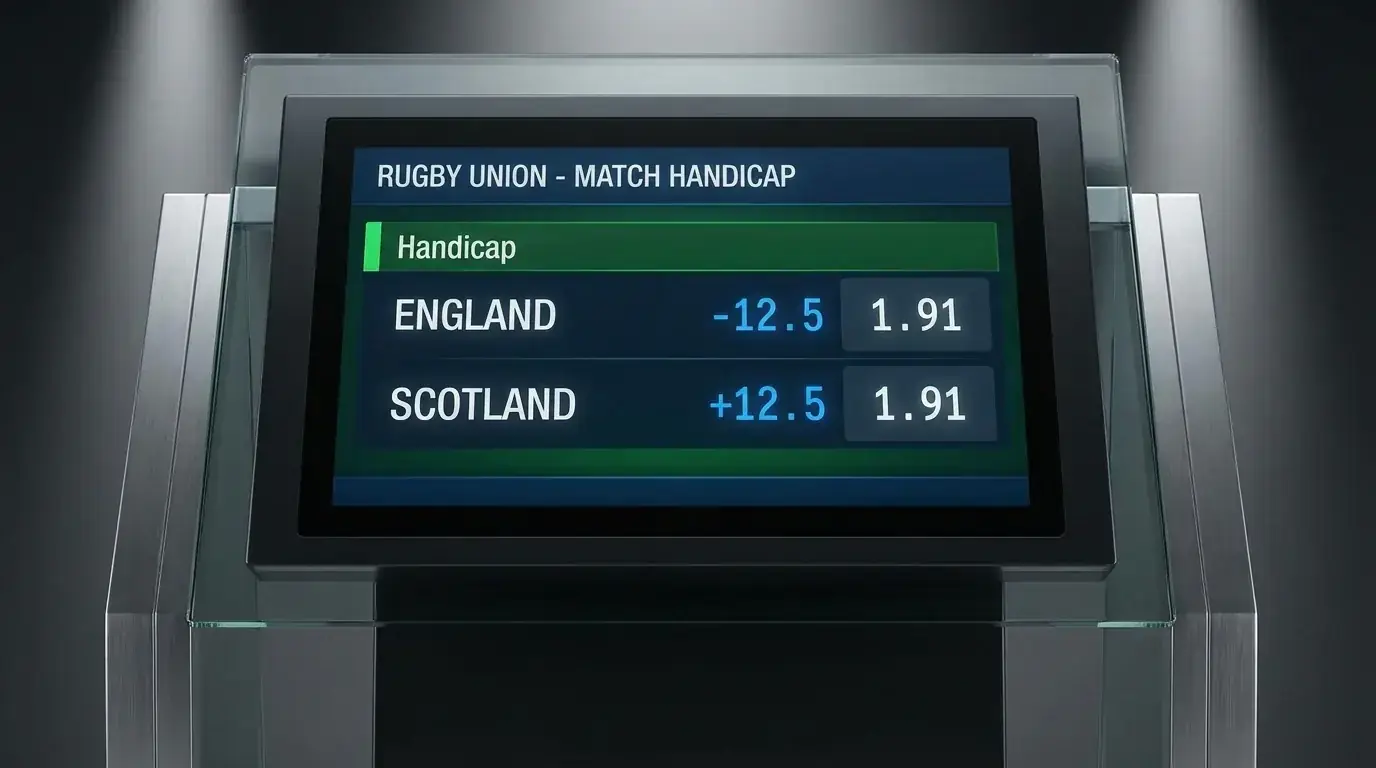
In practice the bookmaker hangs a points figure on each side. The favourite carries a negative handicap, a deficit they must overcome, and the underdog carries a positive one, a cushion they get to keep. Say a strong side is set at minus 12.5 against a weaker one at plus 12.5. To win a bet on the favourite, they must win the actual match by 13 points or more, because you subtract 12.5 from their final score before settling. To win a bet on the underdog, they need only lose by 12 or fewer, or win outright, because you add 12.5 to their tally. The half-point in the 12.5 is deliberate: it removes the possibility of an exact tie on the handicap, so there’s always a clear winner and loser on the bet.
The favourite and underdog prices on the handicap sit much closer to even money than the match result does, often both around 1.90 in decimal, because the line is designed to make the two outcomes roughly equally likely. That’s the whole point of it. Instead of backing an overwhelming favourite at 1.10, where you risk ten to win one, you’re backing them to cover a margin at a price near even money, where the reward actually justifies the stake. The handicap takes a mismatch and rebuilds it into a fair fight, on paper at least.
You’ll sometimes see the handicap written with a sign and a price together, like minus 12.5 at 1.90, which reads as: this team must win by 13-plus, and if they do, your stake returns 1.90 times itself. Get comfortable with that shorthand, because it’s how every book in Britain presents the line, and reading it fluently is the first step to betting it well.
Why the Handicap Dominates Rugby Betting
I’ll put it bluntly: rugby is too predictable for the match result to be interesting most of the time. A small group of elite nations and clubs win the overwhelming majority of meaningful fixtures, and the market knows it, which is why backing them outright pays so little. The handicap exists because the bare result is so often a foregone conclusion that the only live question is the margin.
The numbers underline how concentrated rugby betting is around exactly this idea. Match outcome and margin markets together make up around 60% of all rugby bets, and only about 5% of all bettors touch rugby at all, which tells you the people who do bet the sport are a relatively informed, self-selecting group who’ve worked out where the value sits. They’ve found the handicap. Regional tournaments, the Six Nations, the Premiership, the URC, also drive more than half of all rugby betting turnover, and these are precisely the competitions where the same strong sides dominate season after season, making the margin the natural battleground.

Compare it to football for a moment. In football, draws are common and upsets routine, so the three-way match result, home, draw, away, carries genuine uncertainty and reasonable prices. Rugby has almost no draws and far fewer upsets, which collapses the value out of the match result and pushes it into the handicap. When a top side is 1.08 to win, there’s nothing to bet. When that same side is minus 15.5 at 1.90, suddenly there’s a real question, will they win comfortably or scrape home, and a real price to back your answer.
The predictability also makes the handicap more readable than it would be in a chaotic sport. Because the strong sides perform consistently, their typical winning margins form patterns you can learn. A dominant international side beating a mid-tier one tends to win by a recognisable range, and the bookmaker’s line will sit somewhere in that range. Your job becomes assessing whether this particular match, with these conditions, this team news, this venue, will land above or below the line, and that’s a question rugby’s consistency actually lets you answer with some confidence. The very feature that ruins the match result, predictability, is what makes the handicap tractable.
This is why, when newcomers ask me where to start once they’ve grasped the basics, I point them at the handicap before anything exotic. It’s where the sport’s structure works in a thinking punter’s favour rather than against them, and where a genuine read on a match translates into a price worth taking rather than a return too small to bother with.
Reading the Line Correctly
The single most common handicap mistake I see isn’t bad judgement about a match. It’s misreading which way the points apply, backing a team to cover and then realising you’d misunderstood the sign. So let me drill the reading until it’s automatic, because the maths is trivial once the direction is clear.
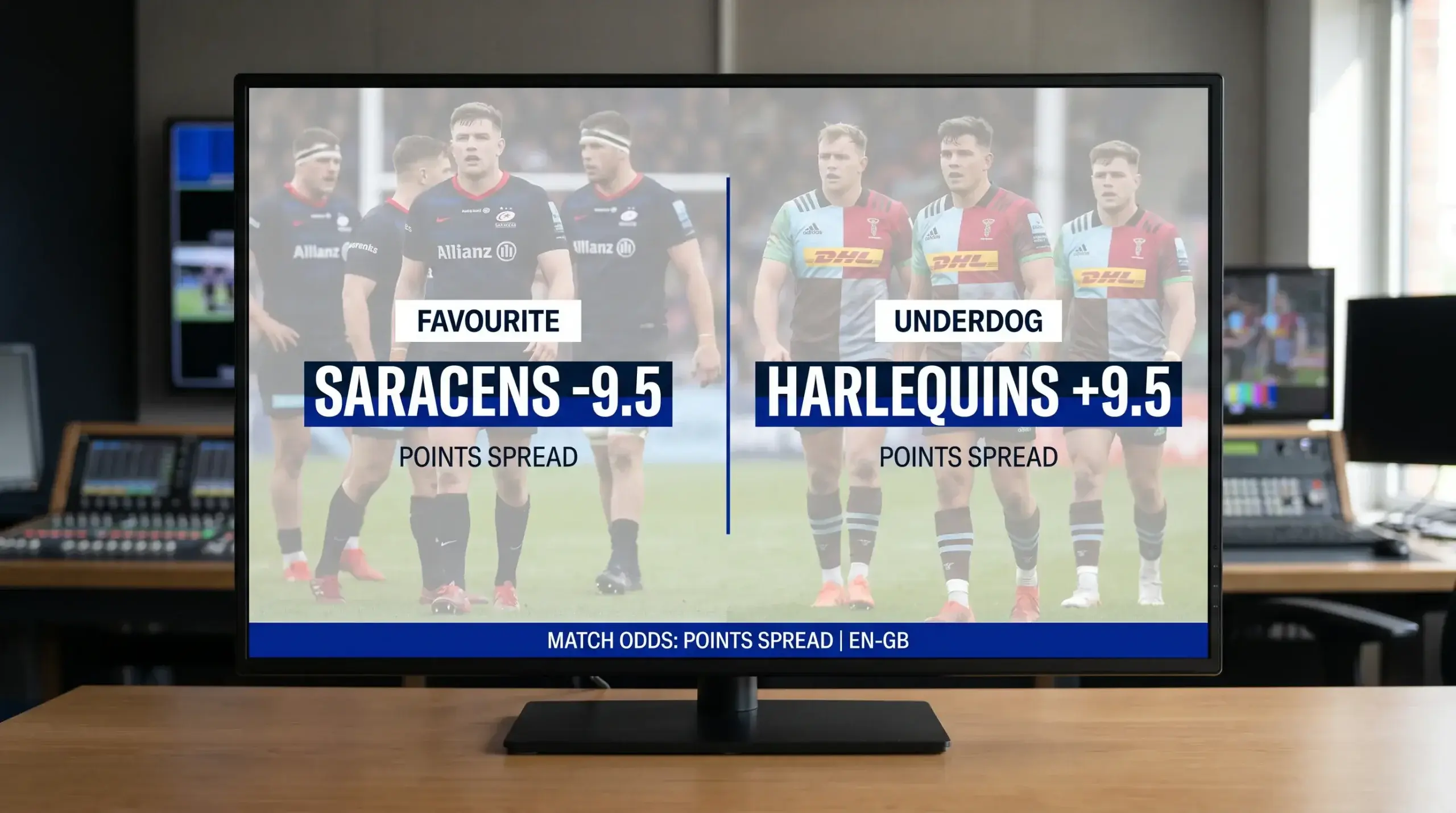
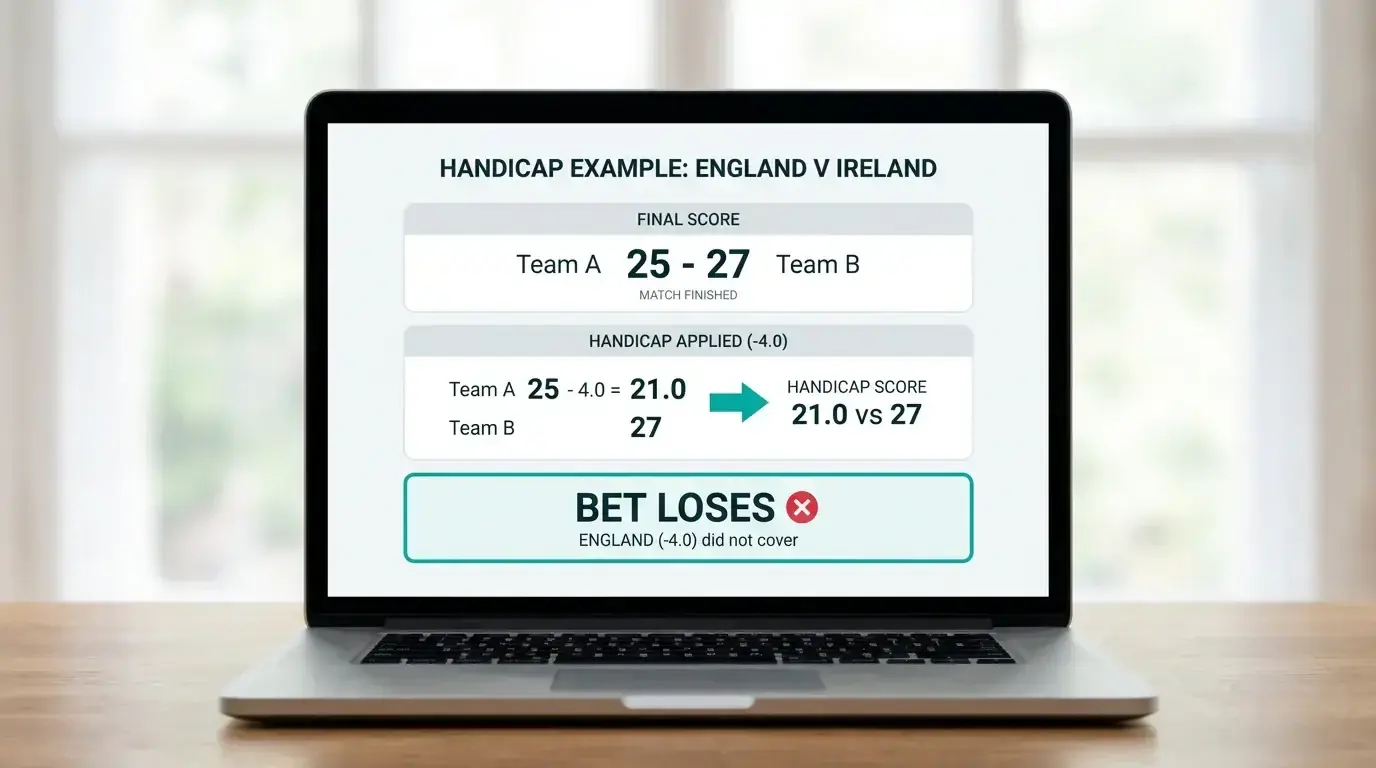
The negative number is subtracted from that team’s final score. The positive number is added. That’s the entire rule. If you back the favourite at minus 9.5, you take their actual final score, subtract 9.5, and compare it to the opponent’s score. If the favourite wins the real match 24 to 13, you subtract 9.5 to make it 14.5 to 13, and the favourite still wins on the handicap, so your bet lands. If they win 24 to 17, you subtract 9.5 to make it 14.5 to 17, and now the favourite loses on the handicap despite winning the match, so your bet goes down.
From the underdog’s side, you add their handicap. Back the underdog at plus 9.5 and the same 24 to 17 result becomes, after adding 9.5 to their 17, a handicap score of 24 to 26.5, so the underdog wins the bet. The underdog covers whenever they lose by fewer points than their handicap, draw, or win outright. The favourite covers whenever they win by more than their handicap. The half-point guarantees one of those two things happens, with no possibility of a push.

A practical habit that eliminates errors: before you bet, state the bet to yourself as a margin requirement, out loud if you have to. “I’m backing the favourite minus 12.5, so they need to win by 13 or more.” “I’m backing the underdog plus 7.5, so they can lose by up to 7 and I still win.” Translating the sign into a plain-English margin removes the ambiguity that catches people out. The number stops being an abstract figure and becomes a concrete threshold the match either clears or doesn’t.
Watch for whole-number handicaps too, which some books offer, like minus 12 rather than minus 12.5. With a whole number, an exact result on the line, the favourite winning by precisely 12, produces a push, where your stake is simply returned. Most rugby handicaps use the half-point to avoid this, but not all, so check whether you’re on a line that can push before you assume a near-miss is a loss. It might be a refund.
Worked Examples That Make It Click
Theory only goes so far, so let me run three realistic scenarios, the kind you’ll meet on any rugby weekend, and settle each one fully. We’ll use fictional but plausible matches and prices so you can follow the settlement step by step.
First, a clear favourite. A top Six Nations side hosts a struggling one. The match result has the favourite at 1.10, which is barely worth the effort. The handicap sets them at minus 15.5 at 1.90, the underdog at plus 15.5 at 1.90. You judge the favourite, at home and at full strength, will win comfortably, so you back minus 15.5. The match finishes 31 to 12, a 19-point win. Subtract 15.5 from the favourite’s score and they win the handicap 15.5 to 12. Your £10 at 1.90 returns £19. Had they won only 24 to 12, a 12-point margin, you’d have lost, because 12 falls short of the 15.5 line.
Second, a closer contest. Two well-matched Premiership clubs, the home side a slight favourite. The handicap is tight: home minus 3.5 at 1.90, away plus 3.5 at 1.90. You like the away side’s recent form and back them at plus 3.5, meaning they need only stay within three points or win outright. The match ends 22 to 20 to the home side, a 2-point margin. Add 3.5 to the away score, making it 22 to 23.5, and the away side covers. Your £10 returns £19, even though your team lost the actual match. This is the handicap’s quiet magic: you can back a loser and still collect.
Third, a heavy mismatch where the favourite still disappoints. A dominant international side faces a minnow, and the line is steep: favourite minus 28.5 at 1.90. You back them, expecting a rout. But it’s a wet day, the favourite rests key players, and they win only 26 to 7, a 19-point margin. Subtract 28.5 and the favourite loses the handicap. Your bet goes down despite a comfortable-looking 19-point victory, because the line demanded 29-plus. This is the lesson that stings newcomers: a big winning margin can still miss a big handicap, and the steeper the line, the more the conditions and team selection matter.
Run those three through your head a few times and the pattern settles in. The handicap isn’t about who wins. It’s about a threshold, and every bet is a judgement on whether the match clears it. Once you’re settling these instinctively, you’re reading rugby the way the market does.
Handicap Versus the Moneyline
The moneyline, the plain who-wins market, and the handicap are answering different questions, and understanding when each is worth your money is the heart of betting rugby well. The short version: the moneyline is for genuine contests, the handicap is for mismatches, and rugby serves up far more mismatches than contests.
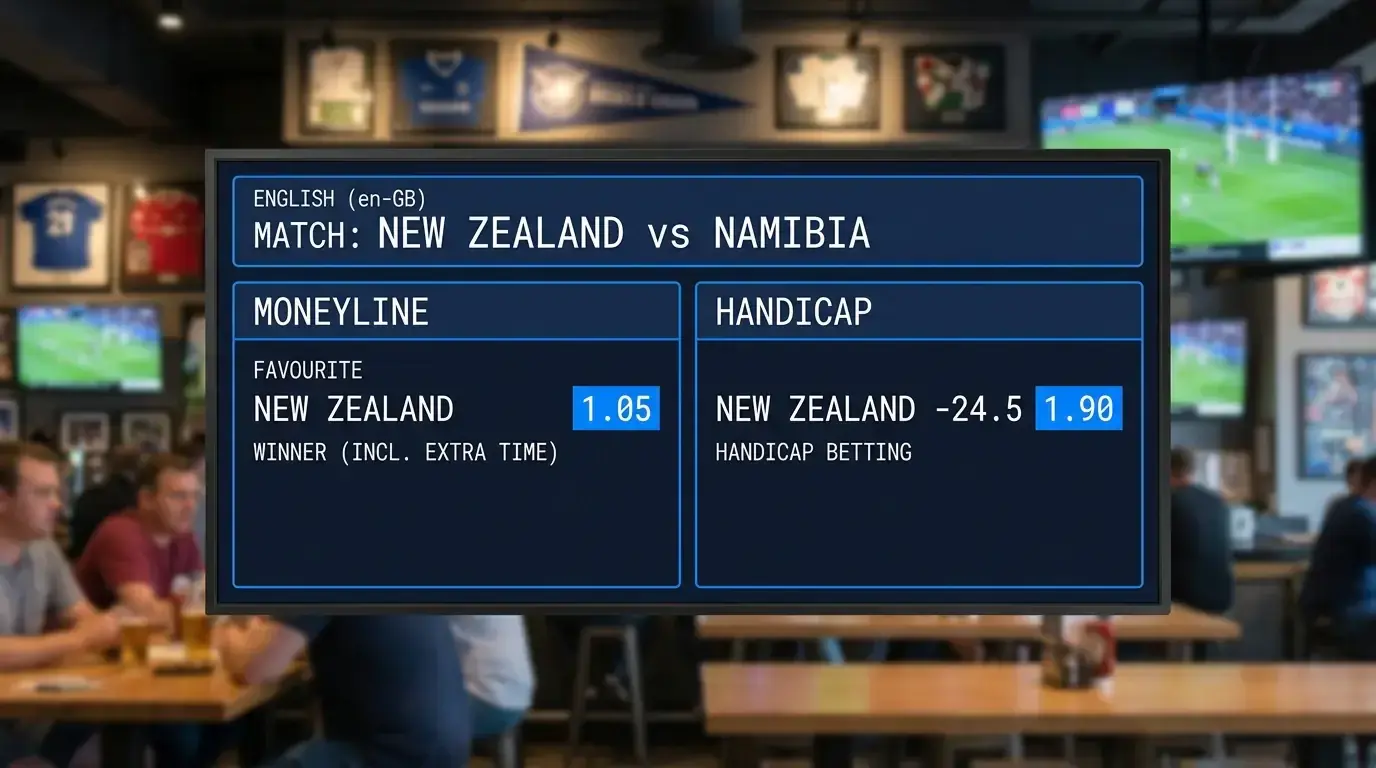
Back a strong favourite on the moneyline at 1.10 and you’re risking £10 to win £1. To make that worthwhile you need to be right roughly nine times out of ten just to break even after the bookmaker’s margin, and a single upset, however rare, erases a long stretch of those slim returns. The arithmetic is brutal: short-priced favourites offer poor value not because they lose often but because the reward is so thin that the occasional loss outweighs a pile of wins. This is the slow bleed I mentioned at the start.
The handicap reshapes that same favourite into a near-even-money proposition. Instead of 1.10 to win the match, you might get 1.90 to win by 13-plus. Now a correct judgement returns almost your stake again, and the risk-reward actually makes sense. You’ve swapped a question you can’t profit from, will the better team win, for one you can, will they win by enough. In a predictable sport, that second question is where skill earns its keep.
There’s a flip side worth respecting. The moneyline comes into its own in tight matches, two evenly matched sides where the result genuinely hangs in the balance and the prices reflect real uncertainty. In those games the handicap line sits near zero and offers little edge, while the match result carries a fair price on a fair question. The skill is recognising which kind of match you’re looking at: a mismatch, where the handicap is your tool, or a coin-flip, where the moneyline is honest. Rugby’s structure means most marquee fixtures lean towards the former, but not all, and forcing the handicap onto a genuine 50-50 is as much an error as backing a 1.05 favourite to win.
I’d put it this way to any punter finding their feet. Default to the handicap when the moneyline price on the favourite is short enough to be uninteresting, which in rugby is most of the time. Reach for the moneyline only when the contest is genuinely close and the price honest. Get that selection right, which market to use for which match, and you’ve internalised the most important strategic distinction in rugby betting.
Finding Value in the Handicap Line
A handicap bet wins not when you pick the right team but when you out-judge the bookmaker on the margin, and that’s a narrower, more skilful task than it sounds. The line the book sets is its best estimate of the fair margin, shaded with its own profit. Your edge comes from the matches where that estimate is wrong, and knowing where to look for those is what separates a punter who bets handicaps from one who beats them.
Conditions are the first place value hides. A steep handicap, a favourite at minus 25 or more, assumes a free-flowing, high-scoring match where the better side can run up the margin. Football may be Britain’s biggest betting sport, drawing roughly 5.8% of the population and over £1.1 billion in gross gambling yield, but rugby’s punters are a smaller, more specialist crowd precisely because reading a market like the handicap rewards the kind of close attention casual football betting never demands. Wet weather, a heavy pitch, or a swirling wind compresses scores and makes big margins harder to achieve, which quietly favours the underdog’s plus line even though the bookmaker may have set the number in dry-day conditions. Reading the forecast against the line is one of the simplest edges available, and most casual punters ignore it entirely.
Team selection is the second, and in rugby it’s enormous. A handful of players, a world-class fly-half kicking the goals, a destructive back row winning the collisions, swing margins far more than any single footballer does. When a favourite rests key men ahead of a bigger fixture, the realistic margin shrinks even if the win remains likely, and a line set before the team sheet dropped becomes beatable. The talkingrugbyunion editorial team, summarising the regulator’s findings, noted that major sporting events continue to play an important role in betting engagement within regulated markets, and it’s in exactly these high-profile fixtures, where team news moves fast and money floods in, that the sharpest handicap value appears and disappears within hours.
Motivation and context form the third source. A side that’s already secured a tournament position may ease off in a dead-rubber final round, suppressing the margin against a line set on form alone. A team chasing points difference to win a title, by contrast, will push for every score, inflating margins beyond the bookmaker’s expectation. The economics of these tournaments make the stakes real, the Six Nations alone generated over $135 million in broadcast media value in 2025, and that money rides on results that carry the kind of motivational edge a handicap punter can read and price.

The method that ties it together is forming your own margin estimate before you look at the line. Decide what you think a fair handicap would be, then compare it to the bookmaker’s. If you’d have set the favourite at minus 10 and the book offers minus 15.5, there’s value in the underdog’s plus 15.5, because the book is demanding a bigger margin than you believe is likely. If your number and theirs match, there’s no edge and no bet. This discipline, your estimate first, their line second, is the entire game, and it’s why handicap betting rewards thought in a way the moneyline never can. For the variant that takes this margin-thinking a step further, splitting the line and refunding part of a stake, the Asian handicap’s split-line mechanics are worth understanding once the standard line is second nature.
How the Line Shifts by Tournament
The same handicap principles apply everywhere, but the character of the line changes sharply depending on which competition you’re betting, and matching your approach to the tournament is the final layer of doing this well. A line in a one-sided international pool stage behaves nothing like a line in a tight domestic league, and treating them the same is a quiet way to lose.
International rugby, the Six Nations, autumn tests, World Cup pool stages, produces the steepest handicaps because the gulf between top nations and the rest is so wide. Lines of minus 20, minus 30, even more in extreme mismatches are common, and these big lines are the most sensitive to conditions and team selection, because the margin needed is so large that any suppressing factor, weather, rotation, a slow start, can pull the result short of it. Betting steep international handicaps is really betting on whether a dominant side will be ruthless or merely comfortable, and that’s a judgement about intensity as much as ability.
Domestic league rugby, the Premiership and the URC, tends towards tighter lines because the clubs are more evenly matched than international sides. Here you’ll see handicaps of minus 3.5 to minus 12.5 far more often than the giant lines of the international game, and the value lives in form, home advantage, and the grind of a long season, fatigue, injuries, fixture congestion. The margins are smaller, so small factors matter more, and a single key absence can flip a tight line. These are the games where diligent, week-to-week knowledge of the clubs pays off, because the lines are too close for the broad-brush dominance of international rugby to guide you.
Rugby league adds another texture again. League is a higher-scoring, faster game with its own margin patterns, and the handicaps reflect a sport where leads can be built and overhauled differently than in union. The principles transfer, the line is still a margin threshold, but the typical numbers and the way matches reach them differ, so you can’t simply port your union instincts across without recalibrating.
The practical takeaway is to specialise. The punter who knows one tournament deeply, its sides, its venues, its rhythms, will read its handicap lines far better than the generalist skimming across all of them. Pick the competition you actually watch and understand, learn how its margins typically fall, and bet the handicap there. The line rewards specific knowledge, and the tournament you follow most closely is where your edge over the bookmaker is largest, because that’s where your read on the margin is sharpest and theirs is just one estimate among many.
