


How to Bet on Rugby Online: The Complete UK Guide for 2026
Six winters ago I watched a mate stake forty quid on Scotland to beat England outright at Twickenham, lose it inside eighty minutes, then tell me rugby was "too random" to bet on. He had it exactly backwards. Rugby is one of the most structurally predictable sports a UK punter can touch, and that predictability is precisely why the smart money rarely sits on the moneyline at all.
This guide covers betting on both codes of the oval ball on UKGC-licensed platforms: rugby union, the fifteen-a-side game that fills Six Nations weekends, and rugby league, the thirteen-a-side code that drives Super League and the Challenge Cup. The two share a name and a ball, and almost nothing else when it comes to how the markets behave. I have spent six years pricing, modelling and betting these tournaments, and the single most useful thing I can tell a beginner is this: because four to six top nations dominate international rugby year after year, the result of most matches is close to a foregone conclusion. That kills the moneyline as a source of value and pushes everything interesting into handicap and total points markets instead.
That structural quirk shapes the whole guide. Football betting is built around upset risk because mid-table sides beat title contenders often enough to keep moneyline prices honest. Rugby is built around margin. When France are 1/20 to beat Italy, nobody serious backs France to win; they bet whether France cover a 21-point handicap, or whether the game goes over 50.5 total points. It is also a niche market by global standards, generating roughly 8.26 billion dollars in betting turnover in 2025, around 5 percent of the worldwide sports betting market, with growth running near 8.1 percent a year. A niche market means thinner liquidity, slower line movement and bookmakers who price some competitions almost as an afterthought, and for a disciplined punter that is opportunity, not a warning.
This is a guide to understanding rugby betting markets, not a recommendation to bet. Every operator mentioned in the wider sense must hold a UK Gambling Commission licence to serve UK residents, and every bet you place should sit inside limits you have set in advance. If betting has stopped being fun, the responsible-betting tools built into every licensed site exist for that moment.
What This Guide Gives You in Sixty Seconds
- Rugby is structurally predictable, so handicap and total points markets offer more value than backing favourites to win outright.
- Both codes trade on UKGC-licensed sites only: union is fifteen-a-side, league thirteen, and they price very differently.
- The UK remote betting sector turns over 16.8 billion pounds GGY a year, yet rugby is only about 5 percent of the global market, so secondary rugby markets stay soft and competition is thin.
- Set deposit limits before your first bet, learn fractional and decimal odds, and treat the Six Nations as your busiest, sharpest window of the year.
The Numbers That Frame Every UK Rugby Bet
Ask ten punters how big British betting actually is and nine will lowball it by an order of magnitude. The remote betting sector in Britain produced 16.8 billion pounds in gross gambling yield in 2025, the single largest slice of the country's gambling economy. Gross gambling yield, or GGY, is simply the amount operators keep after paying out winnings, the cleanest way to measure how much real money flows through these markets. When a number that size sits behind your bet slip, the prices you see have been shaped by serious volume and serious modelling.

16.8bn
UK remote betting GGY in 2025, the largest gambling segment in the country.
290m
Online bets placed each month in Britain on real-world events, around 290.03 million.
10%
Share of the UK population that bets on sport online, against 47 percent who gamble in some form.
5%
Rugby's share of the global betting market, worth about 8.26 billion dollars in turnover.
The monthly volume is what surprises people most. Britain places around 290.03 million online bets on real events every month, and a meaningful chunk lands on rugby during the right weeks of the calendar. High volume is the punter's friend because it forces operators to keep prices competitive across the popular markets, even if they leave the obscure ones loose. The participation rate cuts the other way: roughly 10 percent of the UK population bets on sport online, while 47 percent gamble in some form across all products. Rugby betting is therefore a niche inside a niche, served by a minority of an already selective audience. You are not competing against a crowd of sharp rugby specialists the way you would against football traders, so the competition is thinner, the operator attention patchier, and the rewards for actually knowing the sport correspondingly larger.
Put those four figures together and the strategic picture writes itself. Enormous overall liquidity keeps the headline rugby markets fair, a modest knowledgeable base keeps the secondary markets soft, and rugby's small global share means even the biggest books treat it as a side dish. If you understand the sport better than the average punter, the maths is quietly on your side.
Union and League Are Two Different Bets
The first time I priced a Super League match using my rugby union instincts, I got monstered. I had the favourite's handicap pitched far too low, because I was thinking in union scoring patterns, and league simply does not behave that way. The codes look similar enough on a highlights reel that newcomers assume the betting transfers across. It does not, and treating them as one sport is the fastest way to hand a bookmaker your stake.

Rugby union is the fifteen-a-side game, built around contests for possession: scrums, lineouts, rucks and the maul, the driving formation that gives this site its name. Possession is fought over constantly, so territory and set-piece dominance often matter more than attacking flair. Rugby league is the thirteen-a-side code, stripped of most of those contests, with a six-tackle structure that hands the ball over and keeps the game flowing at higher pace. The practical betting consequence is that league games tend to produce higher, more fluid scoring, while union games can be ground out in the forwards.
Maul — a formation in rugby union where players bind onto a ball-carrier and drive forward as a unit. It is a possession and territory weapon, and the kind of structural feature that makes union scoring patterns differ from league.
Those scoring differences flow straight into the markets. Total points lines sit higher in league because tries come more frequently and the six-tackle set keeps the ball in play. Handicaps behave differently too, since league favourites can pull away in bursts where union favourites tend to accumulate points more steadily through penalties and territory. If you have only ever bet union, do not assume your feel for a fair handicap survives the switch to league. It will not.
| Feature | Rugby union | Rugby league |
|---|---|---|
| Players per side | 15 | 13 |
| Possession contests | Scrums, lineouts, rucks, mauls | Six-tackle set, minimal contest |
| Typical scoring | Lower, territory-driven | Higher, faster, try-heavy |
| Flagship UK competitions | Six Nations, Gallagher Premiership, URC | Super League, Challenge Cup |
| Total points lines | Generally lower | Generally higher |
For UK punters the calendar reinforces the split. Union owns the headline international weeks through the Six Nations and the autumn tests, while league anchors a long Super League season and the knockout drama of the Challenge Cup final at Wembley. You can comfortably bet both, but keep separate mental models for each, because the way try frequency and totals diverge between the codes is worth understanding before you commit real money to league markets you learned in union.
Getting Started Without Getting Burned
Most people's first rugby bet is an impulse. England are kicking off against Wales in twenty minutes, a friend sends a link, and suddenly there is money on a market you do not really understand placed with a site you have never checked. I have watched that exact sequence cost beginners far more than the bet itself, because the rushed account is rarely the safe account. Starting properly takes about fifteen minutes and saves a lot of grief.

The non-negotiable first step is verifying that the site holds a UK Gambling Commission licence. The UKGC was created under the Gambling Act 2005, and any operator serving UK residents is legally required to hold its licence and to provide player-protection tools such as deposit limits and self-exclusion. That licence is not bureaucratic decoration. It is the difference between your funds being ring-fenced and your complaints being heard, versus having no recourse at all if something goes wrong. An unlicensed site might offer a tempting price, but you are trusting it with your money and your data on nothing but its word.
A UKGC licence brings concrete protections: your deposited funds are subject to safeguarding rules, your personal data falls under UK protection law, and the operator must offer working responsible-gambling tools. Verifying the licence before you deposit is the cheapest insurance in betting, and it costs nothing but a minute of your time.
Once you have a licensed home for your account, the mechanics are straightforward: register with accurate details, complete identity verification, set your deposit and loss limits during setup rather than later, and make a modest first deposit. The order matters, because setting limits before you ever place a bet means the decision is made with a cool head, not in the heat of a comeback you are desperate to chase.
Before your first rugby bet, confirm every line
- The site displays a valid UKGC licence and you have checked it rather than taken it on trust.
- You have set a deposit limit and a loss limit that you can comfortably afford to lose.
- You understand the specific market you are backing, not just the teams involved.
- You know whether the odds are shown in fractional or decimal format and can read both.
- The stake is money earmarked for entertainment, never money you need for anything else.
One habit worth borrowing from experienced punters is holding more than one account, though with discipline rather than greed. On average, UK online bettors hold three accounts with operators, 56 percent are registered with more than one, and the reason is sound: prices differ between books, and taking the best available line on a given market measurably improves long-term returns. The risk is that multiple accounts make it easier to lose track of total spend, so if you go this route, your deposit limits matter more, not less.
None of this is complicated, but it rewards patience. The punters who last are the ones who treated their first fifteen minutes as setup rather than a sprint to the first bet. If you want the full click-by-click walkthrough of choosing a site, building a slip and confirming a stake, the step-by-step beginner's route through placing your first rugby bet from a UK account covers every action in order.
The Bet Types That Actually Matter in Rugby
Here is a statistic that should reshape how you think about rugby betting: match outcome and margin bets account for around 60 percent of all rugby wagers, and roughly 5 percent of all bettors touch rugby at all. The market is concentrated in a handful of bet types, which is good news for a beginner, because you do not need to master forty exotic markets. You need to understand four or five and know which one fits the match in front of you.

Match result is the obvious starting point and, in rugby, often the least useful. You are simply backing one side to win, but in a sport where the strongest nations win the overwhelming majority of their fixtures, the favourite's price is frequently so short it offers no value, while the underdog's reflects a genuine probability of getting hammered. This is why the moneyline is where rugby betting starts and rarely where it should end. The handicap market is rugby's centre of gravity, which is why it earns its own section later. In short, the bookmaker awards a points start to the underdog and a points deficit to the favourite, turning a lopsided fixture into a roughly even-money proposition. Total points, the over/under market, asks whether the combined score will exceed a set line, and it is where your read on weather, playing styles and tournament context can really pay.
Handicap — a market where the bookmaker adjusts the final score by a set number of points, giving the underdog a head start, so that backing either side pays close to even money rather than reflecting a near-certain result.
Beyond the core trio sit the rugby-specific markets that make the sport fun to bet. First and anytime try scorer let you back players to cross the line, winning margin asks for the exact range of the final gap, method of scoring covers whether points come from a try, penalty or drop goal, and the bet builder lets you combine several of these into a single priced selection on one match.
Example of a typical rugby market spread for a clear favourite
| Market | Fractional | Decimal |
|---|---|---|
| Favourite to win | 1/20 | 1.05 |
| Favourite -21.5 handicap | 9/10 | 1.90 |
| Over 50.5 total points | 10/11 | 1.91 |
| First try scorer, leading winger | 4/1 | 5.00 |
This is an illustrative spread, not a real fixture. Notice how the win market at 1/20 offers almost nothing, while the handicap and total sit near even money. That contrast is the whole argument for looking past the moneyline.
The accumulator, or acca, deserves a word of warning. Combining several selections multiplies the odds and the appeal, but it also multiplies the bookmaker's margin against you, since you need every leg to land. Master the handicap and the total first, because those two markets, more than any flashy bet builder, are where rugby's structural predictability turns into an actual edge.
Reading the Price Before You Read the Match
A reader once emailed me convinced he had found a bookmaker error: the same match showed 4/1 on one site and 5.00 on another, and he thought one was wildly more generous. They are identical prices in different clothes. That confusion between fractional and decimal odds catches out more UK beginners than any tactical misjudgement, and it is the easiest thing to fix.
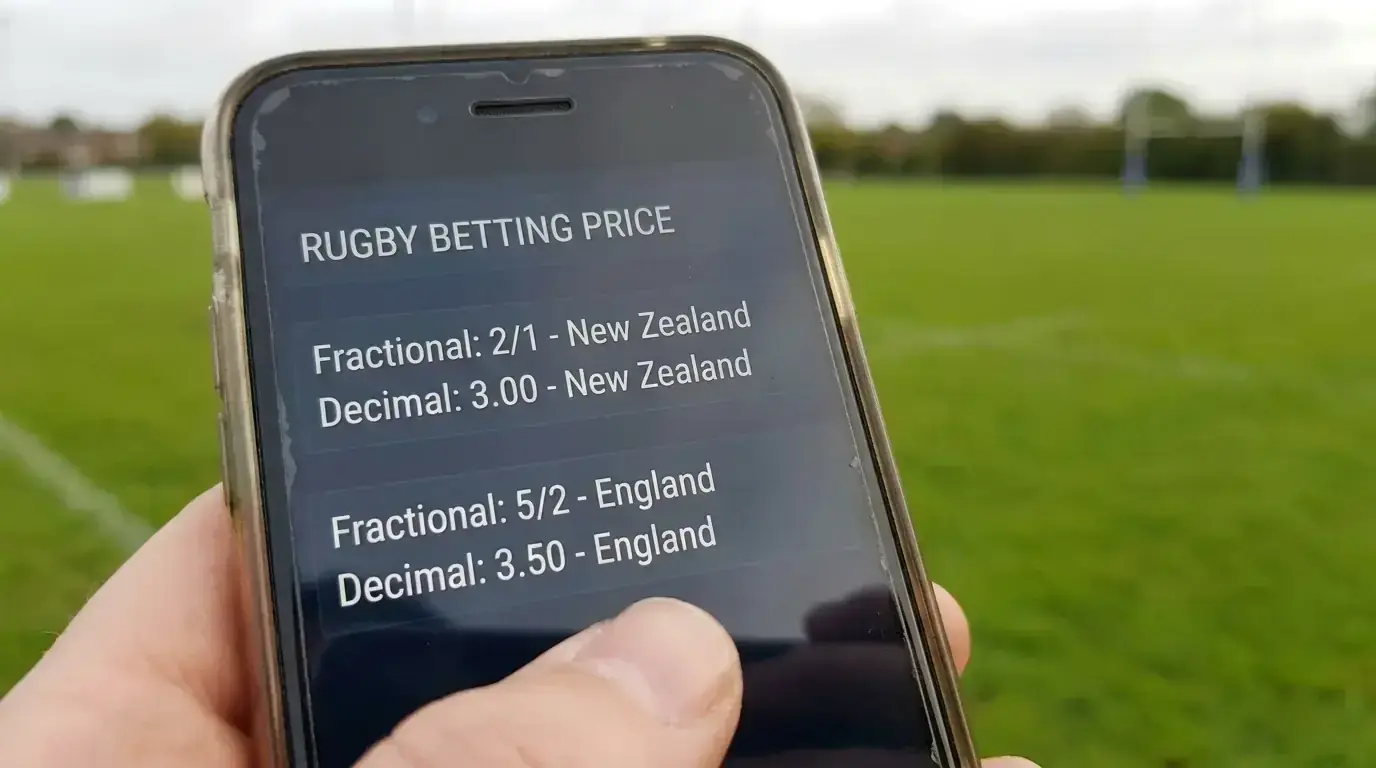
British bookmakers traditionally display fractional odds, the 4/1 or 9/10 format, while most of the rest of the world and many in-play interfaces use decimal odds like 5.00 or 1.90. Fractional odds tell you profit relative to stake: 4/1 means a one-pound stake returns four pounds profit plus your pound back. Decimal odds tell you total return including stake: 5.00 means a one-pound stake returns five pounds in total. The two always describe the same underlying probability, so 4/1 and 5.00 are the same bet, just as 9/10 and 1.90 are.
The same prices in both UK formats
| Fractional | Decimal | Implied probability |
|---|---|---|
| 1/2 | 1.50 | about 67 percent |
| Evens, or 1/1 | 2.00 | 50 percent |
| 9/10 | 1.90 | about 53 percent |
| 4/1 | 5.00 | 20 percent |
The number that actually matters is hiding in that third column. Every price carries an implied probability, the chance of winning that the odds represent. Decimal makes the conversion easy: divide 100 by the decimal price and you get the implied percentage, so 5.00 implies a 20 percent chance and 1.90 implies roughly 53 percent. The reason every market's probabilities add up to more than 100 percent is the bookmaker's built-in margin, the overround, and learning to spot it is the foundation of finding value rather than just guessing winners.
For everyday rugby betting you need to be fluent enough to glance at a price in either format and instantly sense whether it is generous or mean. That fluency is what separates a punter who bets on feel from one who bets on numbers. The full mechanics of converting between formats, calculating implied probability and stripping out the overround to judge true value are worth studying properly, and a dedicated walk through how fractional and decimal rugby prices translate into real probability will take you from recognising a price to genuinely understanding it.
Why the Handicap Is Rugby's Real Market
If you take one idea from this entire guide, make it this one. In a sport where match outcome and margin bets make up around 60 percent of all rugby wagers, the handicap is not a niche alternative to backing a winner. It is the main event. The reason traces straight back to rugby's structural predictability: when the result is barely in doubt, the only interesting question left is by how much.

A handicap works by giving the underdog a head start measured in points and the favourite a deficit of the same size. Imagine a favourite set at minus 21.5 points. To win your bet on the favourite, they must not merely win the match but win it by 22 or more. Back the underdog at plus 21.5 and you win if they lose by 21 or fewer, or pull off the upset outright. The bookmaker has taken a fixture that might be 1/20 on the moneyline and rebuilt it into something close to an even-money contest, which is where genuine value can live.
The handicap turns "who wins" into "by how much", and in rugby the second question is far harder for bookmakers to nail than the first. A dominant side winning is easy to price. A dominant side winning by exactly enough to cover 21.5 points, against a specific opponent in specific conditions, is where your knowledge of form, weather and motivation counts.
This is why I steer beginners away from the win market so firmly. Betting whether France cover a 21-point handicap is a balanced proposition you can reason about: how France travel, how Italy defend at home, whether the weather suits a kicking game. The same knowledge that feels useless on the moneyline becomes decisive on the line.
Standard European handicaps use a single line with a half-point to avoid a tie, but the wider family includes Asian handicaps that split your stake across two lines and winning-margin markets that ask for an exact range. Getting the full picture of how the line beats the moneyline is the most profitable study a rugby punter can undertake, and a deeper analysis of why points handicaps outperform backing favourites outright lays out the reasoning and the line-reading skills in full.
Interactive tool
Rugby handicap calculator
Set the handicap line and a scoreline to see who covers, by how much, and whether your bet lands. Because in rugby the question is rarely who wins — it's by how many.
- Handicap result Underdog +21.5 covers by 0.5
- Match result Favourite by 21
- Total points Under 50.5 by 5.5
- Return on your betat 1.90 · 9/10 £0.00
The Tournaments That Drive UK Rugby Betting
Every February something shifts in the British betting calendar. For six weekends the Six Nations puts rugby alongside football and horse racing as one of the most active betting products of the period, lifting wagering on the sport sharply through February and March. If you only bet rugby seriously a few weeks a year, these are the weeks: the liquidity is at its deepest, the media coverage saturates, and the markets are at their sharpest, which cuts both ways for a punter.

The Six Nations is the commercial engine of northern hemisphere rugby. It generated 135.24 million dollars in media revenue from broadcast agreements across the UK, France, Italy and Ireland for its 2025 edition, and the prize pot reached 18 million pounds, with champions France taking 6.5 million. Those numbers matter to a bettor because money on that scale means relentless coverage, granular data and enormous public interest, all of which deepen the markets you are betting into.
The core UK rugby union calendar runs the Six Nations in February and March, the Gallagher Premiership and the United Rugby Championship through the domestic season, and the autumn internationals in November. Rugby league frames the year differently, with a long Super League season building to the play-offs and the Challenge Cup final at Wembley. Knowing which competition is live tells you where the liquidity and the sharpest prices will be.
Beyond the Six Nations, the Gallagher Premiership and the United Rugby Championship, the URC, carry the union club season for British and Irish sides, while the Top 14 in France and the Rugby Championship in the southern hemisphere fill out the international picture. The autumn internationals in November pit the home nations against touring southern sides and tend to throw up less predictable results, since teams are still finding form, which shifts the value toward more genuine moneyline interest than during a settled Six Nations. On the league side, Super League anchors a long domestic season whose play-offs reward punters who track form over months, and the Challenge Cup delivers knockout drama where upsets are common and outright prices on the Wembley final can offer real value early.
The Six Nations is so commercially gravitational that its 2025 edition was carried under 32 separate media-rights agreements across the UK, France, Italy and Ireland. That web of broadcast deals is what turns six weekends in late winter into the most concentrated burst of rugby betting interest in the British year.
The practical lesson is to match your betting to the calendar rather than forcing rugby bets year-round. During the Six Nations, expect tight, efficient markets where your edge comes from genuine insight. During quieter domestic weeks and the league knockouts, the secondary markets soften and the rewards for knowing an unfashionable fixture grow. Build your year around those rhythms and you will bet less often but far better, which in this game is exactly the trade you want.
How Big Audiences Become Better Prices
There is a direct line, often invisible to casual punters, between how many people watch a match and how good the betting markets on it are. The bigger the audience, the more money flows in, the harder operators work to price it accurately, and the more competitive the odds you can shop for. The numbers behind rugby's biggest occasions are startling.

The 2023 Rugby World Cup in France racked up 1.33 billion hours of viewing, the most-watched rugby event in history. The final between South Africa and New Zealand alone drew 94 million hours of viewing, a record for a single match. Numbers on that scale turn a sporting event into a betting phenomenon.
That viewing translates into liquidity in a way every punter benefits from. When 1.33 billion hours are spent watching a tournament, the betting markets attached to it are deep, heavily traded and tightly priced, which protects you from the worst prices. Deep markets are efficient markets, and the danger of getting badly stung on price is highest in the obscure games nobody is watching, not the showpieces everyone is. The flip side is that a slice of the casual free-to-air audience, drawn in by a Six Nations opener peaking at 3.8 million viewers on ITV, drifts into the markets as the least informed money there. It tends to pile onto favourites and popular narratives, which can leave value on the less glamorous side of a bet.
This is the quiet advantage of betting a sport with a big television footprint but a small specialist base. The takeaway is not to avoid the big-audience fixtures but to read the crowd: when public money floods one side of a market during a heavily watched match, the value often quietly accumulates on the other.
Betting While the Ball Is in Play
The single biggest shift in betting during my six years in the game has been the move from pre-match to in-play, and the numbers behind it are emphatic. Live betting made up 62.35 percent of the betting market's share in 2025. More than half of all wagering now happens after kick-off, while the action unfolds, and rugby's stop-start structure makes it unusually well suited to it.
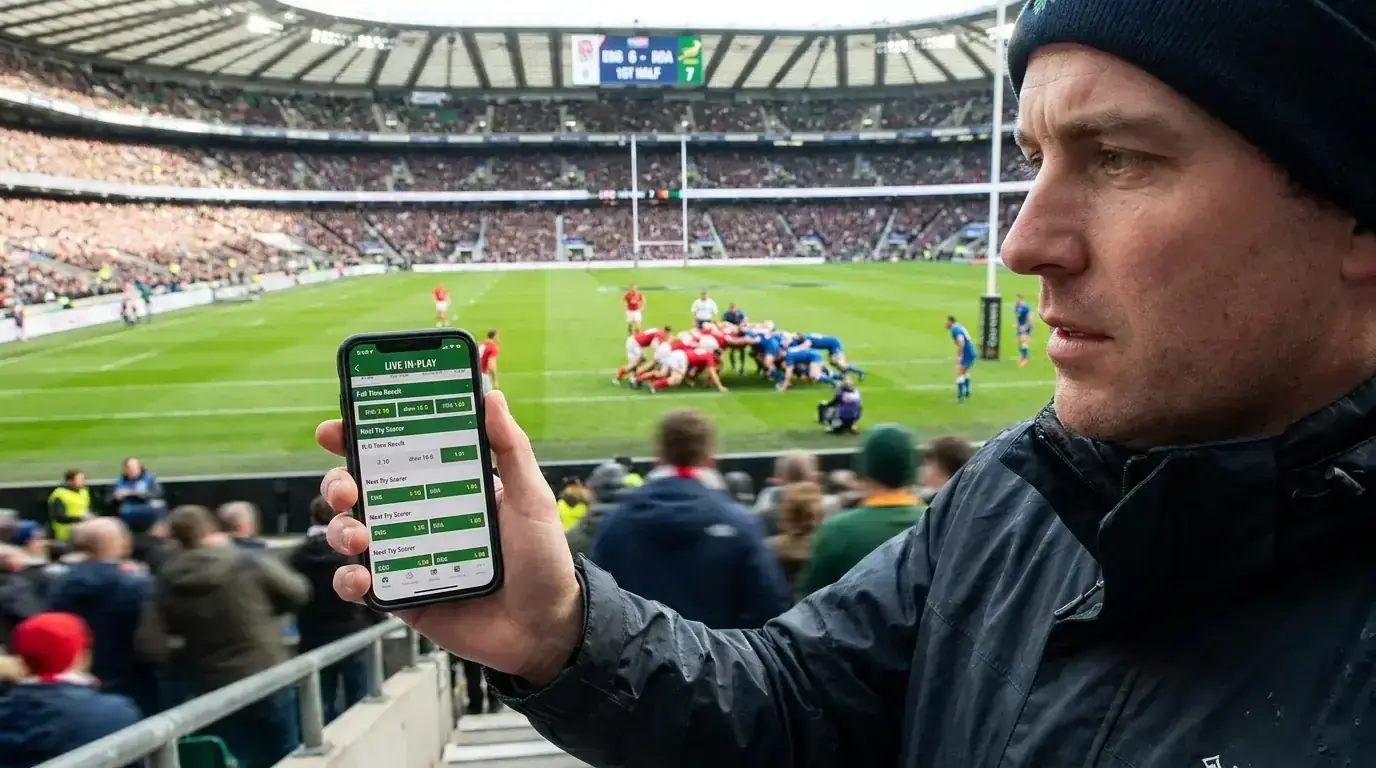
In-play betting, sometimes called live betting, means placing bets while a match is in progress, with odds that shift continuously to reflect the score, the time remaining and the momentum on the pitch. Rugby lends itself to this beautifully. The natural breaks for conversions, penalties, scrums and lineouts give you windows to read the game and react, and the way momentum swings, a yellow card here, a dominant scrum there, creates constant repricing that an attentive viewer can sometimes anticipate.
In-play betting rewards watching over guessing. A handicap that looked fair before kick-off can drift to genuine value after twenty minutes if one side has lost a player to the sin bin or the weather has turned. The punter actually watching the match, rather than refreshing a scores page, holds the advantage in live markets.
For context on how mainstream this has become among British bettors, 21 percent of UK online players had placed an in-play bet in the previous four weeks. That is roughly one in five active punters reaching for live markets within a single month, which tells you in-play is no longer a novelty for the brave but a standard part of how Britain bets. The infrastructure, fast settlement, cash-out options and live data, has matured to support it.
The flip side is that in-play betting compresses your decision time and can encourage impulsive staking, which is why discipline matters more here than anywhere else. The odds move fast, the temptation to chase a swing is constant, and the same momentum that creates opportunity can wipe out a position in a single passage of play. Getting the mechanics right, when to back, when to cash out, how to read the live price, is its own discipline, and a full guide to reading live rugby markets as the match unfolds covers the timing and the traps in detail.
The Phone in Your Pocket Is the New Bookmaker
Walk into any pub during a Six Nations Saturday and count the phones out on the tables. That is where modern rugby betting happens, and the data backs up what the eye sees. Among UK mobile bettors, 32 percent are aged 18 to 24, and the smartphone now dominates as the way people access betting. A whole generation has never queued at a betting shop counter and never will.

The home-and-handset pattern is even more pronounced. In Britain, 95 percent of online gambling happens at home, and among players aged 18 to 24 specifically, 76 percent use a smartphone to do it. The image of the punter studying form in a high-street bookmaker has been replaced by someone on the sofa, phone in hand, placing a bet during the warm-up. For rugby this fits the rhythm of the sport perfectly, since you can set a deposit limit, check a price and place a considered bet in the minutes before kick-off without leaving your seat.
Mobile betting puts the same player-protection tools in your pocket as any desktop site. UKGC-licensed apps must offer deposit limits, time-outs and self-exclusion in the interface, usually within a couple of taps in the account settings. Because the phone makes betting so frictionless, using those built-in limits matters more on mobile than anywhere else.
That frictionlessness is the double edge of mobile betting. The same convenience that lets you place a smart, pre-planned bet in seconds also lets you place an impulsive, regrettable one just as fast, and the only brake left is the one you build yourself through limits set in advance. Used well, though, the phone is the best tool a rugby bettor has ever had: it lets you compare prices across the accounts you hold, react to team news the moment it drops, and bet in-play while watching the match. The technology is neutral; whether it serves your betting or undermines it comes down to the limits and discipline you bring to it.
Looking Ahead to the 2027 World Cup Futures
Futures markets, the long-range bets on who wins a tournament months before it starts, are about to get a lot more interesting, because the next Rugby World Cup is changing shape. The 2027 edition in Australia expands to 24 teams for the first time since 1999, when the field last sat at 20, adding a round of 16, six pools of four, and compressing the window from seven weeks to six, running from 1 October to 13 November 2027. For anyone holding an outright position, that structural change rewrites the probabilities.
The jump from 20 to 24 teams is the biggest format change to the Rugby World Cup in nearly three decades. The new round of 16 means more knockout matches, more upset opportunities and a longer path to the final, all of which feed directly into how futures prices should be calculated.
More teams and an extra knockout round change the futures maths in two directions at once. A larger field dilutes the probability attached to any single favourite, since there are more sides in the draw and one more knockout hurdle to clear. At the same time, the expanded format creates more matches that matter and more chances for a fancied side to slip up against a lower-ranked opponent. World Rugby's chief executive captured the commercial logic plainly, noting that the 2027 tournament will be a more compact event that should generate more interest and bigger audiences.
Bigger audiences, as the earlier numbers showed, mean deeper and more efficient markets, so the 2027 futures are likely to be sharply priced once the tournament draws near. The window of value tends to open early, before the casual money arrives, when bookmakers are still feeling out the implications of a format nobody has bet on before. An untested structure is harder to price, and harder-to-price markets are where a knowledgeable punter occasionally finds an outright worth backing.
The caution with all futures is that your stake is tied up for a long time and a single injury or pool-stage shock can sink a position you cannot easily exit. Treat outrights as a small, considered part of a betting year rather than a centrepiece, and the expanded 2027 field becomes an intriguing puzzle rather than a way to lock money away on a hunch.
Betting Responsibly Under UK Rules
I will be blunt, because this section matters more than any tip in the guide. The whole point of betting is that it stays enjoyable, and the moment it stops, the tools to step back are built into every licensed site for a reason. Problem gambling affects an estimated 0.5 percent of the UK population, a minority, but a serious one, and the entire UK regulatory framework exists to keep that number low. The encouraging news is that the protective tools genuinely work: research has found that regularly using responsible-gambling tools reduces the likelihood of developing gambling problems by around 60 percent. Setting a deposit limit, taking a time-out, tracking your spend, these are not signs of a problem but the ordinary habits of someone who intends to keep betting as a hobby for years rather than burning out in a season.

Deposit limits set in advance are the most effective single safeguard, because they make the important decision when you are calm rather than when you are chasing a loss. Every UKGC-licensed operator is required to offer them, and turning them on takes seconds. The limit you set today protects the version of you having a bad night three weeks from now.
When self-imposed limits are not enough, Britain has a national backstop. The GAMSTOP service lets you exclude yourself from every UK-licensed gambling company at once, for a period of six months, one year or five years. It is a single registration that covers the entire regulated market, with no need to contact operators one by one, and the exclusion holds across all of them for the period you choose. If you ever feel your betting slipping beyond your control, that scheme exists precisely for that moment.
Keep your rugby betting healthy by checking these regularly
- You have active deposit and loss limits, and you have not raised them in a moment of frustration.
- You are betting money set aside for entertainment, never money needed for bills or essentials.
- You are not increasing stakes to recover losses, the single most dangerous habit in betting.
- Betting still feels like fun rather than pressure, and you can comfortably go a week without it.
- You know how to access time-outs and self-exclusion, and you would use them without shame if needed.
The framework around all of this is robust. The UK Gambling Commission, created under the Gambling Act 2005, requires every operator serving UK residents to provide these protections as a condition of holding a licence. That is the real value of betting only with licensed sites: the safeguards are not optional extras but legal obligations. A deeper, practical guide to staying in control of your rugby betting under UKGC rules walks through each tool and how to use it. If betting has stopped feeling like a choice, please treat that as the signal it is and reach for the help the regulated system is built to provide.
What the People Running the Game Are Saying
It is easy to bet rugby in a bubble, watching only the prices, but the people running the sport and the regulated market keep saying things that should shape how you think about it. The clearest signal is how directly the sport's own leadership ties its growth to audience reach. After the 2023 World Cup, World Rugby's chief executive Alan Gilpin called it a fantastic tournament that captured the hearts of millions more worldwide, and that is not just press-release warmth. A sport actively chasing new audiences is one whose betting markets will keep deepening, exactly the trend that benefits anyone betting it seriously.
The regulated-market specialists make a complementary point about where to bet. Techopedia's gambling editor Raymond Van Wyk has observed that expert-reviewed UK bookmakers tend to offer a wider range of betting markets, reaching well beyond the obvious fixtures into more niche tournaments. For a rugby punter that breadth is the whole game, because the value so often hides in the competitions the big operators treat as afterthoughts.
The throughline across these voices is that major events drive engagement, and engagement drives the markets. As one analysis of UK betting trends put it, drawing on the Gambling Commission's own data, major sporting events continue to play an important role in overall betting engagement within regulated markets. For rugby that means the Six Nations and the World Cup are not just spectacles but the structural peaks of the betting year.
What I take from all of this, after six years of listening to it, is a simple instruction: follow the events. The sport's leaders are building toward bigger occasions, the regulated operators are widening their markets, and the data keeps confirming that the big tournaments anchor betting activity. Align your betting with those peaks, bet the breadth that good operators offer rather than only the headline games, and you are moving with the grain of the sport rather than against it.
Common Questions UK Rugby Punters Ask
After six years of fielding the same questions from friends, readers and the bloke next to me at the bar, these are the ones that come up most, with short answers and the deeper material signposted throughout the guide.
How do I start betting on rugby online in the UK?
Choose a UK Gambling Commission licensed site, verify that licence before you deposit, register and complete identity checks, then set deposit and loss limits before your first bet. Pick a market you understand rather than just backing a team, and learn whether the odds are fractional or decimal. The setup takes about fifteen minutes.
What is the difference between rugby union and rugby league betting?
Union is fifteen-a-side, built around possession contests like scrums, lineouts and mauls, with lower territory-driven scores. League is thirteen-a-side with a six-tackle structure and generally higher scoring. So total points lines sit higher in league and handicaps behave differently, and a feel for fair prices in one code does not transfer cleanly to the other.
What are the main rugby bet types?
The core markets are match result, handicap and total points, with match outcome and margin bets making up around 60 percent of all rugby wagers. Beyond those sit first and anytime try scorer, winning margin, method of scoring and the bet builder. The handicap and the total are where rugby's predictability turns into genuine value.
Which rugby tournaments are best for betting?
The Six Nations in February and March is the deepest, most heavily traded window of the rugby year. The Gallagher Premiership and United Rugby Championship carry the union club season, the autumn internationals throw up less predictable November results, and Super League and the Challenge Cup offer their own value, especially in knockout fixtures where upsets are common.
What is in-play rugby betting?
In-play, or live, betting means placing bets while a match is underway, with odds shifting continuously to reflect the score, time and momentum. Live betting now makes up over 62 percent of the market, and rugby suits it because the natural breaks for conversions and set pieces give you windows to read the game.
How do I bet on rugby responsibly under UKGC rules?
Set deposit and loss limits in advance, bet only money set aside for entertainment, and never raise stakes to chase losses. Regularly using these tools reduces the risk of developing gambling problems by around 60 percent. If limits are not enough, GAMSTOP lets you exclude yourself from every UK-licensed operator for six months, one year or five years.
How can I check that a rugby betting site is UKGC-licensed?
Every operator serving UK residents must hold a UK Gambling Commission licence, created under the Gambling Act 2005, and provide protections such as deposit limits and self-exclusion. The licence safeguards your funds and data, so confirming it exists rather than trusting the site is the cheapest insurance in betting. Treat any site that cannot evidence one as off limits.
The thread running through every answer is the UKGC licence. It is what makes deposit limits, self-exclusion and fund safeguards legal requirements rather than goodwill gestures, and it is the first thing to verify before you do anything else on a betting site.
Where the Edge Actually Lives for UK Punters
If my mate from the opening of this guide had asked me for one sentence instead of forty quid on Scotland, it would have been this: stop trying to pick winners and start pricing margins. Everything here circles back to rugby's defining quirk, that the result of most matches is close to settled before kick-off, which is exactly why the handicap and the total, not the moneyline, are where a knowledgeable punter earns their keep. The thin specialist base does the rest of the work for you, leaving the secondary markets softer than the headline prices and rewarding anyone who actually knows the sport. You bring that knowledge to a market where most of the money does not, and that is a real edge.
Bet the calendar, not every fixture. Learn to read a price in both fractional and decimal format before you stake. Treat the handicap and total points as your primary markets and the moneyline as a curiosity. Above all, set your limits before you bet, not after, because the discipline you build off the pitch keeps you betting on it for years.
Do those things and rugby stops feeling random and starts feeling like what it is: one of the most readable sports a British punter can bet, for anyone willing to look past who wins and ask the better question of by how much.
