


A punter messaged me last season convinced his bookmaker had made an error. He had backed a team at -6.75, they won by seven, and instead of a clean win or loss his account showed a part-win and a part-stake returned. No error at all. He had simply stumbled into an Asian handicap without understanding that the half-decimal in that line splits your stake across two outcomes. It is the single most misunderstood market in rugby betting, and once it clicks, it changes how you attack mismatched fixtures.
The Asian handicap migrated into rugby from football, and it solves a specific problem: the standard European handicap forces a result onto a market that often does not deserve one. By using split and quarter lines, it slices the dead-heat possibility out of the equation and gives a punter finer control over risk. It looks alien on a UK coupon dominated by fractional odds, but the logic underneath is cleaner than the standard handicap most people default to.
What an Asian handicap actually does
Strip away the jargon and an Asian handicap is just a head start, or a deficit, applied to the scoreline before bets settle, with one crucial twist: it can hand your stake back rather than lose it outright. As one industry voice put it, betting products have become even more precisely adapted to the needs of users in specific markets, and the Asian handicap is exactly that kind of refinement.

A standard European handicap on a rugby match might offer a favourite at -12.5 and the underdog at +12.5, three outcomes effectively in play across the wider market, including the chance of a draw on the handicap when whole-number lines are used. The Asian version trims this. A whole-number line, say -12, introduces the “push”: if the favourite wins by exactly 12, the handicap is a tie and your full stake is refunded rather than lost. That refund mechanic is the heart of the market and the thing that catches newcomers out.
The practical appeal is reduced variance. By offering lines where a near-miss returns your money instead of busting your bet, the Asian handicap lets you back a favourite to cover a margin without the all-or-nothing cliff edge of a standard line. For rugby, where favourites win predictably but the exact margin is genuinely hard to pin down, that middle ground is valuable. You are still betting on the points gap; you are simply doing it with a safety mechanism baked into certain lines.
Reading split and quarter lines
This is where Asian handicaps earn both their power and their reputation for confusion. The defining feature is the quarter line, a handicap ending in .25 or .75, which quietly splits your stake across two adjacent handicaps. Once you see the mechanism, the mystery evaporates.
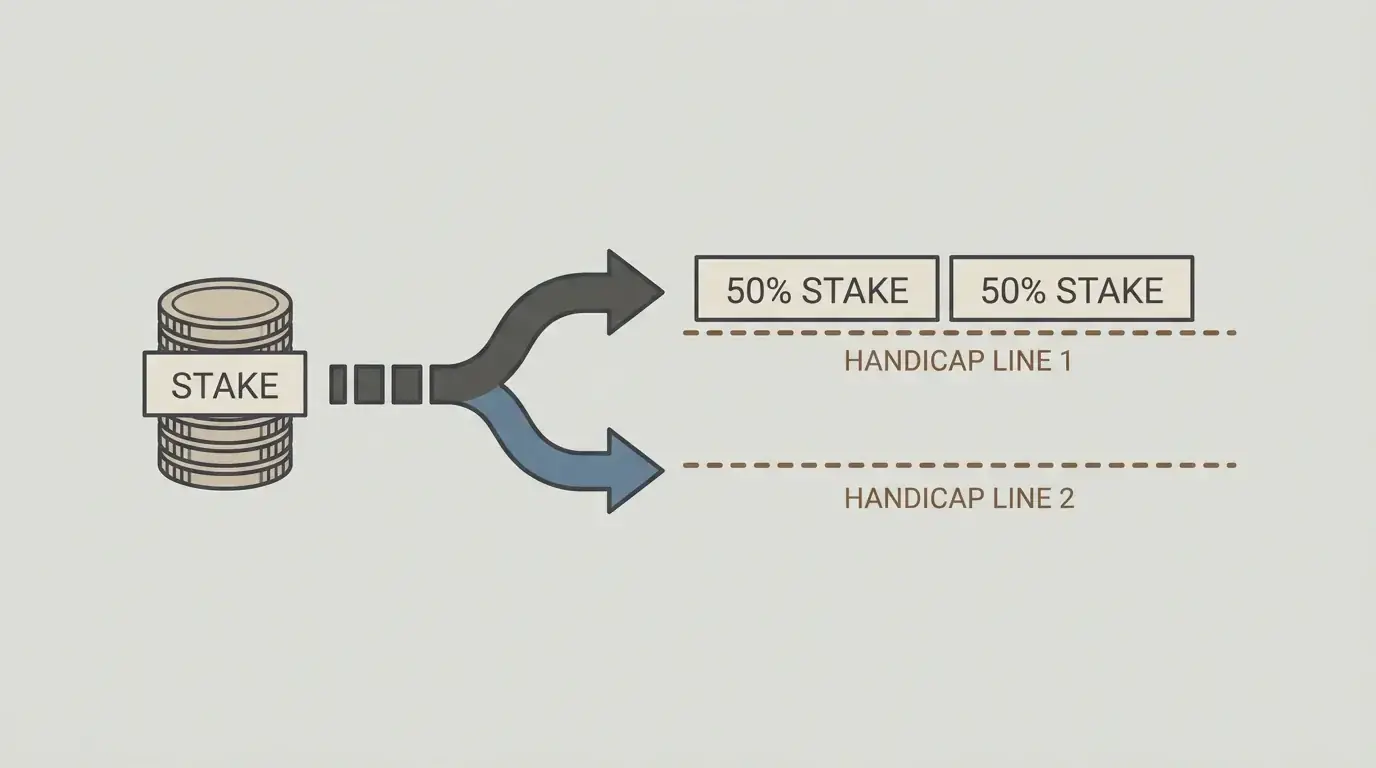
Take a -6.75 line on a favourite. That figure is shorthand for half your stake on -6.5 and half on -7. If the favourite wins by eight or more, both halves win. If they win by exactly seven, the -6.5 half wins and the -7 half pushes, so you collect on half your stake and have the other half refunded, the part-win that baffled my messager. If they win by six or fewer, both halves lose. Around 60% of rugby bets land on match outcome and margin, so refining how you bet that margin with quarter lines is a genuine edge over punters using blunt whole-number handicaps.
The .25 lines work the same way in the other direction. A +2.25 on an underdog splits into +2 and +2.5: if they lose by exactly two, the +2.5 half wins and the +2 half pushes, returning a part-win. Half lines (.5) are the simplest, no push is possible because you cannot win by half a point, so they behave like a clean two-way bet. Whole lines (.0) carry the full push refund on an exact-margin result. Learning to read the suffix, .0, .25, .5, .75, tells you instantly how your stake is exposed, and that is the whole skill of the market.
Asian versus European handicaps in practice
The two handicap styles answer the same question, who covers the margin, but they price risk differently, and choosing between them is a tactical decision rather than a matter of taste. Regional competitions generate over half of all rugby betting turnover, and those domestic fixtures are exactly where the choice between Asian and European lines matters most.

A European handicap is blunt and binary on half-lines but introduces a third “handicap draw” outcome on whole-number lines, which a casual punter often forgets exists, costing them when a match lands exactly on the line. The Asian handicap removes that ambiguity by either splitting the stake or refunding it, so you always know precisely how an exact-margin result settles. That clarity comes at a price: Asian lines are typically priced closer to even money, around 1.90 to 2.00 in decimal, or roughly 9/10 to evens in fractional terms, because the refund mechanic reduces the bookmaker’s edge on near-misses.

For rugby specifically, I lean Asian on predictable mismatches where I am confident a favourite wins but unsure of the exact gap, because the quarter line lets me back the cover while protecting half the stake against a narrow result. I lean European, or a quarter line tighter to the expected margin, when I have a strong read on the precise points difference and want the bigger payout that a more aggressive line offers. Neither is universally better; the Asian gives control and lower variance, the European gives simplicity and occasionally fatter odds. If you want to bet the points gap directly rather than as a head start, my guide to winning margin markets in rugby covers the band-based alternative.
Worked examples to lock it in
Nothing makes the Asian handicap stick like running real numbers, so here are three settlements on a hypothetical favourite, using neutral figures rather than any named team. Imagine the favourite is backed and the match finishes with the favourite winning by a given margin.

First, a half line. You back the favourite at -8.5, decimal 1.95 or roughly 20/21. They win by 12. The margin clears 8.5, so the bet wins cleanly and a £10 stake returns £19.50 in total. A half line is all-or-nothing: had they won by eight, the whole stake would be lost, no refund possible. Second, a whole line with a push. You back the favourite at -10, decimal 1.90 or 9/10. They win by exactly 10. The handicap ties, the bet pushes, and your full £10 stake is returned with no profit and no loss. Third, the quarter line that started this article. You back the favourite at -6.75, decimal 1.90 or 9/10, with a £10 stake split as £5 on -6.5 and £5 on -7. They win by exactly seven: the -6.5 half wins, returning £9.75 on that portion, and the -7 half pushes, returning the £5 stake, for a total return of £14.75 on your £10, a part-win. Run those three settlements until the suffix logic is automatic, and the Asian handicap stops being the market that “made a mistake” and becomes the one you reach for when a favourite is reliable but the exact margin is anyone’s guess.
