
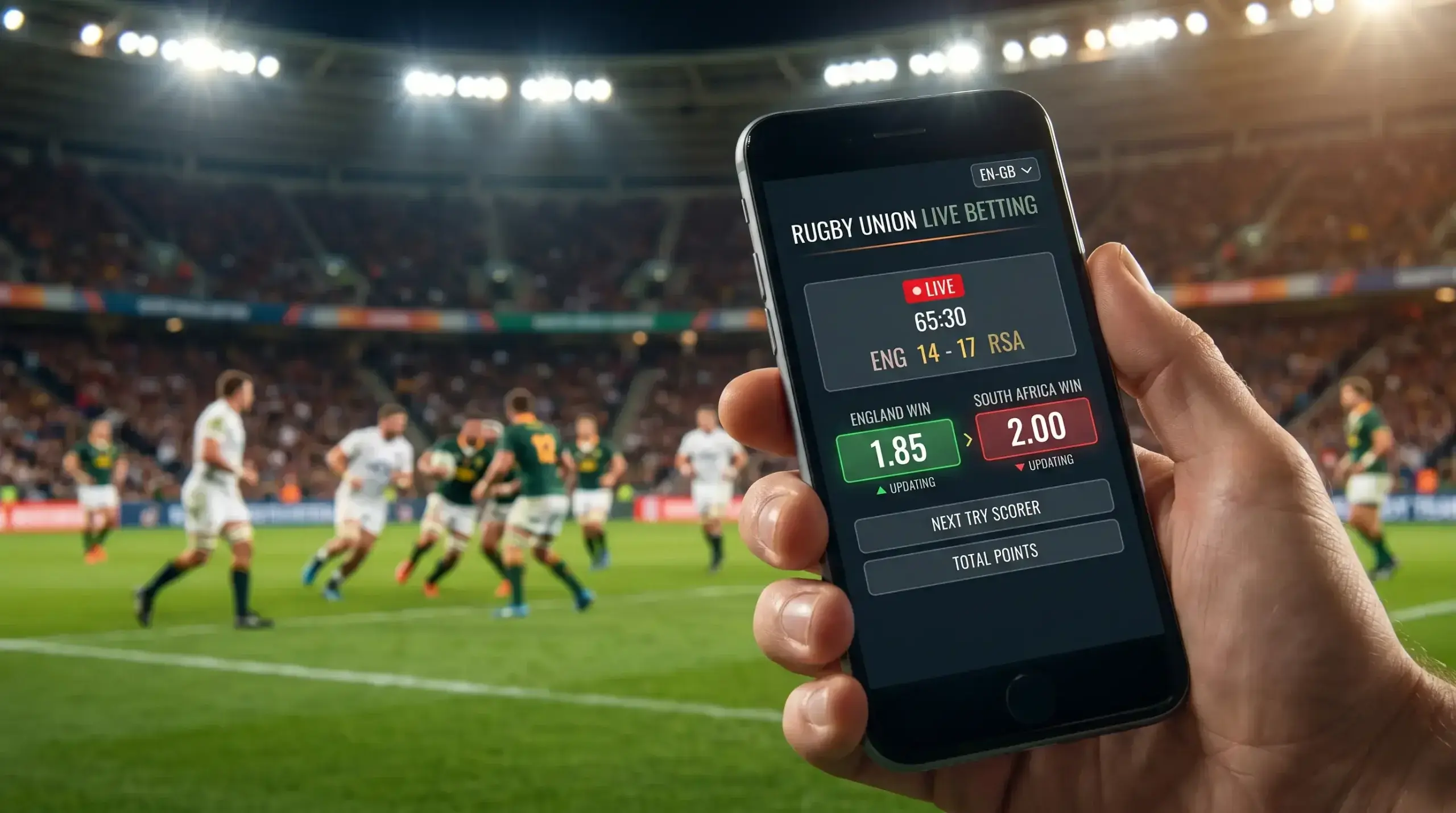

The most expensive thirty seconds in betting happen right after a try. The crowd’s still roaring, the conversion hasn’t been taken, and the live odds are lurching about while half the people watching reach for their phones on pure adrenaline. That moment, repeated dozens of times across a match, is what in-play betting is, and it has quietly become the dominant force in the entire industry. Live and in-play wagering made up 62.35% of the sports betting market in 2025, which means more money now rides on matches in progress than on bets placed before kick-off.
This article is about that live market specifically: how the odds move as the match unfolds, what you can actually bet on once play has started, why the timing of your entry matters more than almost anything, and how to keep your head when the prices are screaming at you. I’m not covering pre-match selection here, that’s a different discipline with a different rhythm. In-play is its own animal, governed by momentum, reaction speed, and the discipline to sit on your hands when the moment isn’t right.
Six years of betting rugby has convinced me that in-play is where the sharpest edges and the worst beatings both live. The punter who understands how live odds respond to events can read value the pre-match market never offered. The punter who just reacts to whatever just happened, chasing the swing, betting the emotion, hands the bookmaker money faster than any other format. The difference between the two is entirely a matter of understanding the mechanics, which is what we’re here to build.
How Live Odds Move During a Match
I once watched a favourite’s price drift from 1.40 to 2.10 in the four minutes it took the underdog to score, convert, and then win a penalty in good field position. Nothing about the favourite’s quality had changed. What changed was the situation, and live odds price the situation, not the reputation. Understanding that distinction is the whole foundation of in-play betting.
A pre-match price reflects everything known before kick-off: form, team news, conditions, history. The instant the match starts, the live price begins absorbing new information in real time, every score, every territorial shift, every yellow card, every minute that ticks off the clock. The bookmaker’s models recalculate constantly, and the number you see is their live estimate of each outcome’s probability given everything that’s happened so far. When a side scores, their win probability jumps and their price shortens. When time runs down with a team in front, their price shortens further simply because there’s less match left for the lead to be overturned.
Two forces drive most rugby in-play movement: the score and the clock. The score is obvious, points change who’s likely to win. The clock is subtler but just as powerful. A seven-point lead with sixty minutes to play is fragile and prices accordingly; the same seven-point lead with five minutes left is close to decisive, and the leader’s price collapses towards 1.10 because there’s simply no time for a comeback. This is why the same scoreline produces wildly different prices depending on when it occurs, and why reading the clock is as important as reading the scoreboard.
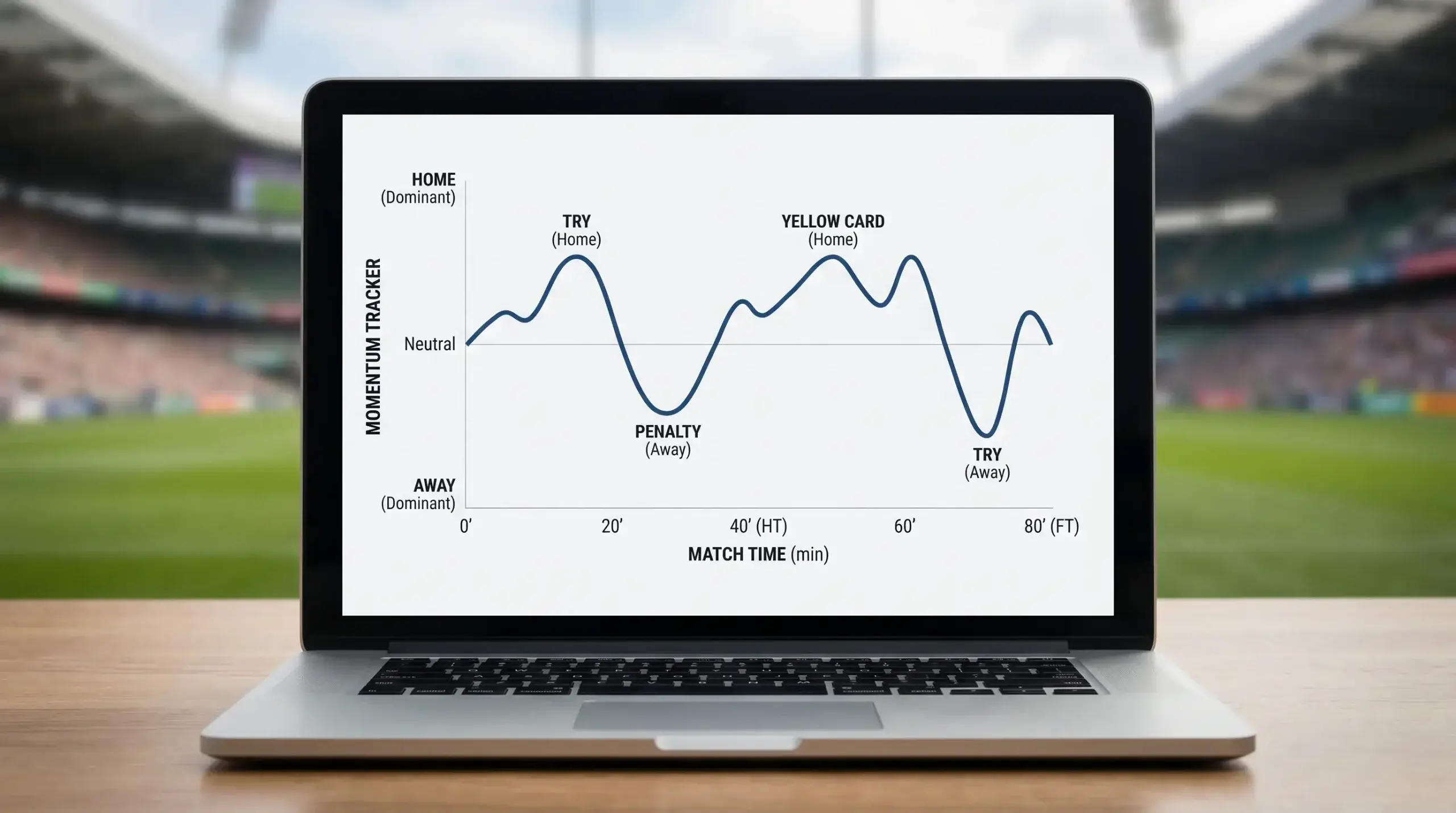
Momentum complicates the picture in rugby specifically. A side camped on the opposition line, phase after phase, is more likely to score imminently than the raw scoreline suggests, and live prices try to capture this by moving even before points go on the board. A penalty advantage, a lineout five metres out, a sustained spell of pressure, all nudge the odds because the model reads them as elevated scoring probability. The skilled in-play punter watches the match, not just the scoreboard, and acts when they judge the situation more dangerous or less dangerous than the price implies.
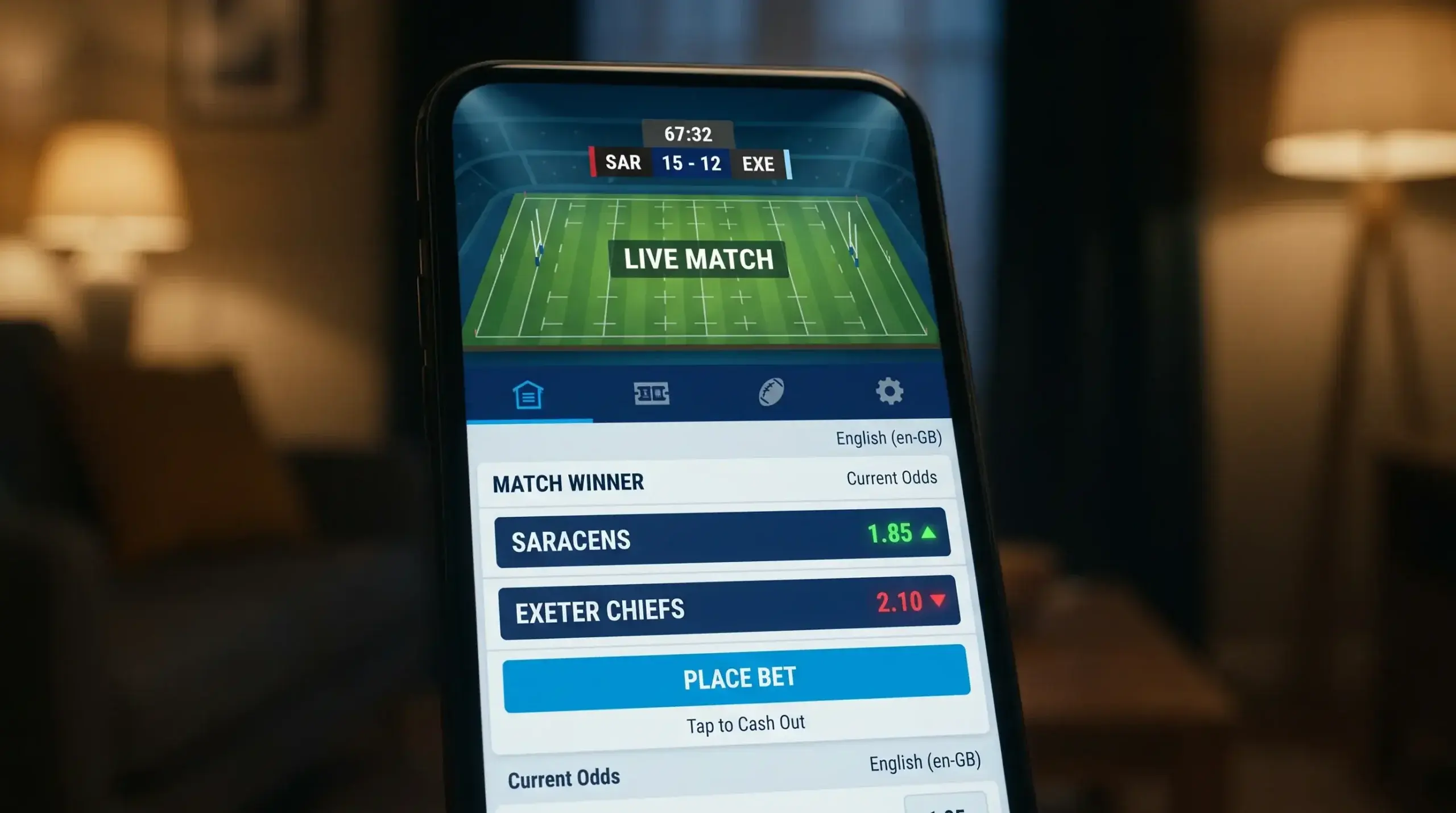
There’s also a mechanical delay you must respect. Live odds suspend briefly during key moments, a try being scored and reviewed, a penalty being lined up, because the bookmaker won’t price uncertainty it can’t yet quantify. The market freezes, then reopens at a new price once the event resolves. You cannot bet during the suspension, and the price you get when it reopens may be very different from the one you were eyeing. That gap between intention and execution is a defining feature of in-play, and learning to anticipate it rather than chase it is half the skill.
The Markets Available Once Play Starts
The menu of in-play markets is wider and stranger than newcomers expect, and knowing what’s on offer shapes how you bet. The headline match result is always there, repriced live, but it’s joined by a host of markets that only make sense once a match is underway, markets built around what happens next rather than what happens overall.
The live match result and live handicap are the staples, the same markets you’d recognise from pre-match but now moving with the game. Alongside them sit markets about the remainder of the match: which team scores next, the points in a given period, whether there’ll be a try in the next ten minutes. These next-event markets are the heart of live rugby betting because they ask a question with a fast, clear answer, and they refresh constantly as one resolves and another opens. The industry has leaned hard into this kind of precision. As BETBY’s commercial chief Sophia Nikolopoulos put it, products have become even more precisely adapted to the needs of users in specific markets, and in-play rugby is a clear example, the markets have multiplied and sharpened to match how people actually watch the game.
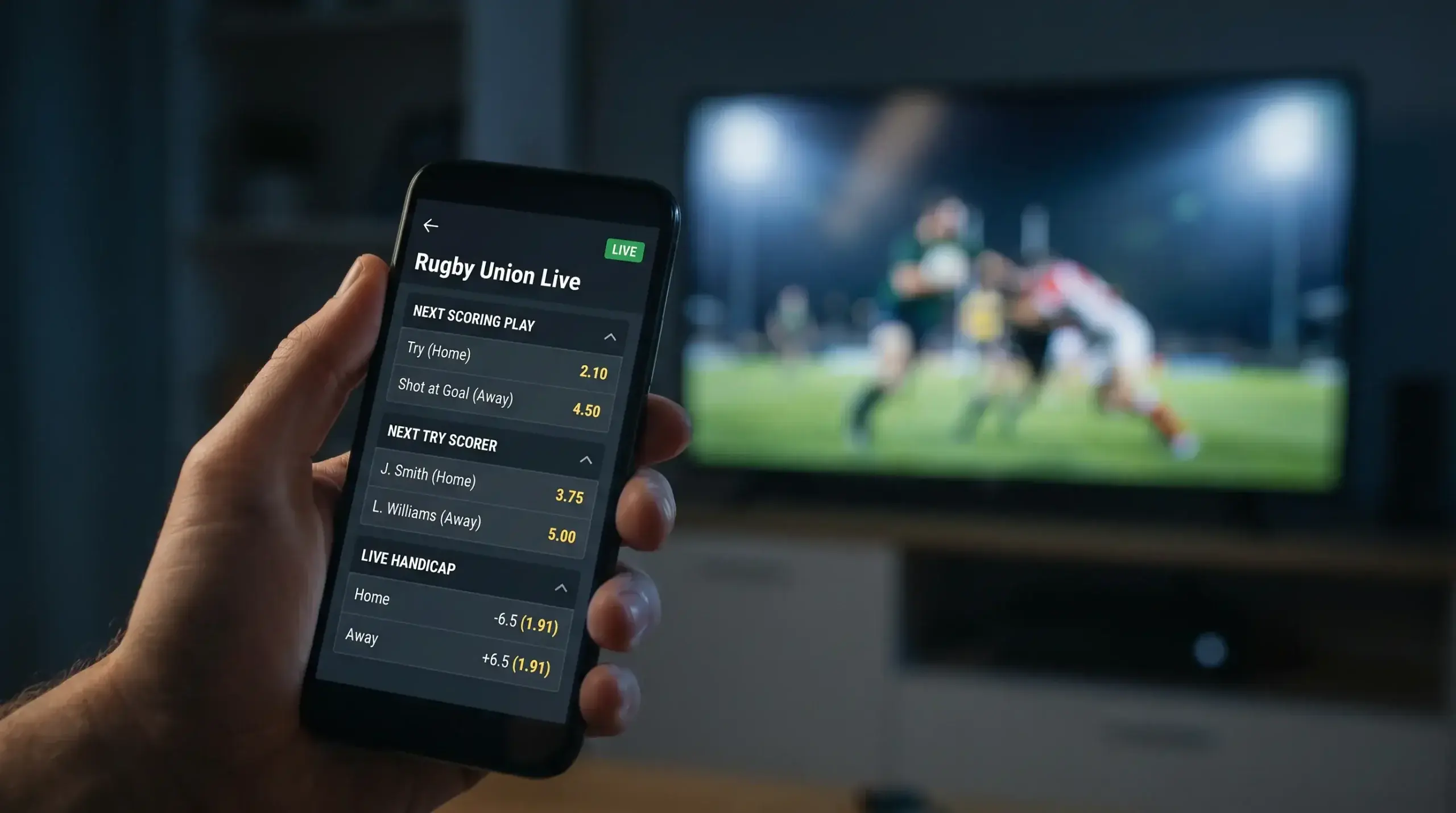
Then there are the granular markets that compress the betting timeframe to its limit, wagers on the very next play or the next scoring action. These shade into what’s properly called micro-betting, where the question is as small as whether the next kick at goal succeeds, and they settle in seconds rather than minutes. They’re exhilarating and they’re punishing in equal measure, because the speed leaves no room for considered judgement, and the volume of bets they invite is exactly what erodes a bankroll fastest. I treat them with real caution and suggest you do the same, at least until the slower live markets are second nature. The mechanics of these fast-settling wagers, and why they demand particular discipline, are worth a deeper look in how micro-betting on the next play actually works.
Total points markets also run live, with the over-under line adjusting as the score climbs and the clock falls. Early in a high-scoring match the line might drift upward as the bookmaker revises its expectation; late in a low-scoring grind it falls as the realistic total compresses. Betting these live is really a judgement on tempo, whether the match will open up or tighten, and rugby’s ebb and flow makes that a genuinely readable question for someone watching closely.
The breadth is the point. A single big rugby match can carry well over a hundred live markets at once, refreshing throughout, and the abundance is both opportunity and trap. The opportunity is that somewhere in that sprawl is a price that’s lagging the situation. The trap is that the abundance invites constant betting, and constant betting is how the bookmaker’s edge grinds you down. Pick your spots from the menu deliberately, rather than grazing it because it’s there.
Live Markets Against Pre-Match
People ask me whether in-play or pre-match is the better way to bet rugby, and the honest answer is that they reward opposite strengths, so the right choice depends on what kind of punter you are. Pre-match rewards research and patience. In-play rewards reading the live situation and acting decisively. Neither is superior; they’re different games played on the same fixture.
The structural shift towards live betting is undeniable. On some platforms more than half of all turnover now comes from in-play wagering, a remarkable inversion from the days when betting meant placing a slip before kick-off and watching it ride. The reason is partly psychological, the live market is simply more engaging, more responsive, more like being part of the match, and partly that the watching experience and the betting experience have merged into one. You no longer bet and then watch; you watch and bet continuously, and the in-play market is built to make that frictionless.
Pre-match betting has real advantages the live market can’t match. You have time. You can research the team news, weigh the conditions, compare prices across books, and form a considered view before committing a penny. The price you take is the price you’ve thought about, not the price the moment thrust at you. For a punter whose edge comes from preparation and judgement rather than reaction speed, pre-match is the natural home, and the discipline of deciding before kick-off protects you from the emotional swings that wreck live bettors.
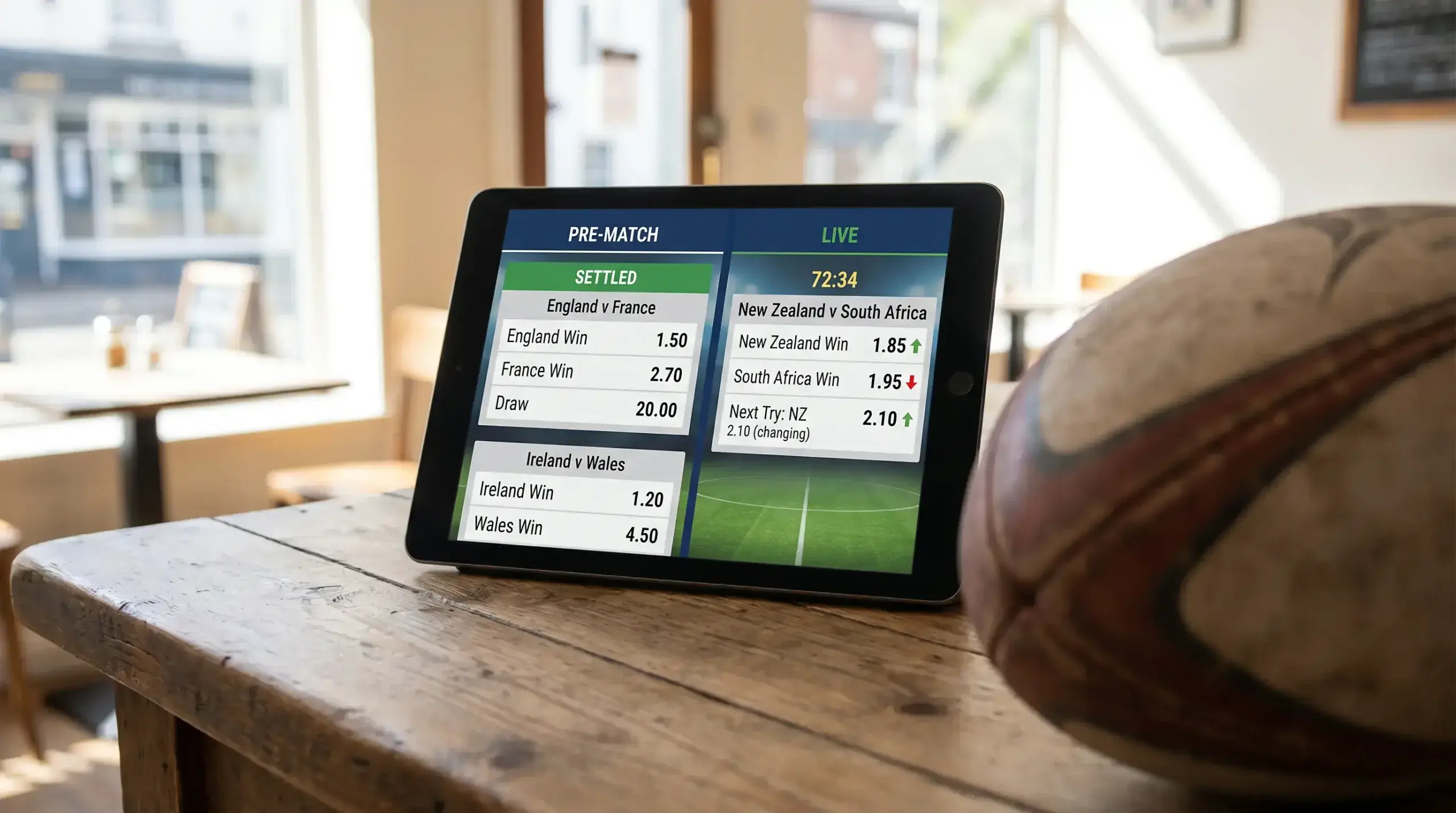
In-play’s advantage is information. By the time you bet live, you’ve seen the match start, you know how the sides have set up, you’ve watched the early exchanges that no pre-match analysis could predict. A favourite who’s started slowly, a key player who’s limping, a referee whistling the breakdown tightly, all of this is visible live and priced imperfectly, which is where the edge hides. The live punter trades the luxury of time for the advantage of evidence, and for someone who reads matches well, that trade can pay.
My own practice blends them, and I’d recommend the same. Form a pre-match view, take a position if the price is right, then use the live market selectively, only when the unfolding match reveals something the pre-match price didn’t account for. The worst approach is to abandon all preparation and simply react to the live feed, betting whatever just happened. That’s not in-play betting, it’s gambling on your own adrenaline, and the market is built to profit from exactly that impulse.
Cash Out and the Tyranny of Timing
Cash out is the feature that feels like control and often functions as a tax. It lets you settle a bet early, before the match ends, for a value the bookmaker calculates based on the current situation, locking in a partial profit or limiting a loss. It’s enormously popular and enormously misunderstood, and getting your relationship with it right is central to betting live well.
Here’s how it works. You backed a side pre-match at 3.00, they’re now leading and their live price has shortened to 1.40, so the bookmaker offers to buy back your bet for more than your stake but less than your full potential return. Take it and you bank a guaranteed profit now rather than risking the full outcome. The appeal is obvious: certainty in an uncertain moment, a profit in hand rather than a profit at risk. The catch is equally real: the cash-out figure is calculated with the bookmaker’s margin baked in, so you’re systematically offered slightly less than the bet is mathematically worth.
The timing of cash out is where punters torture themselves. Cash out too early and you leave profit on the table when your selection goes on to win comfortably. Hold too long and a late swing, a converted try in the final minutes, wipes out a position you could have banked. There’s no formula that gets it right every time, because you’re trying to predict the rest of a live match, which is precisely what you couldn’t do before kick-off and can’t do much better now. The feature offers the illusion that you can manage the outcome, when mostly you’re just choosing your moment to pay the bookmaker’s margin.
I use cash out sparingly and for one purpose: managing genuine risk, not chasing optimal value. If a bet has become uncomfortably large relative to my bankroll because the position swung my way, or if circumstances have changed in a way that makes me want out regardless of price, cash out is a legitimate tool. What I don’t do is treat it as a profit-maximising game, repeatedly cashing out and re-betting, because every cycle through that loop pays the margin again and the cumulative cost is severe. The feature is a brake, not an accelerator.
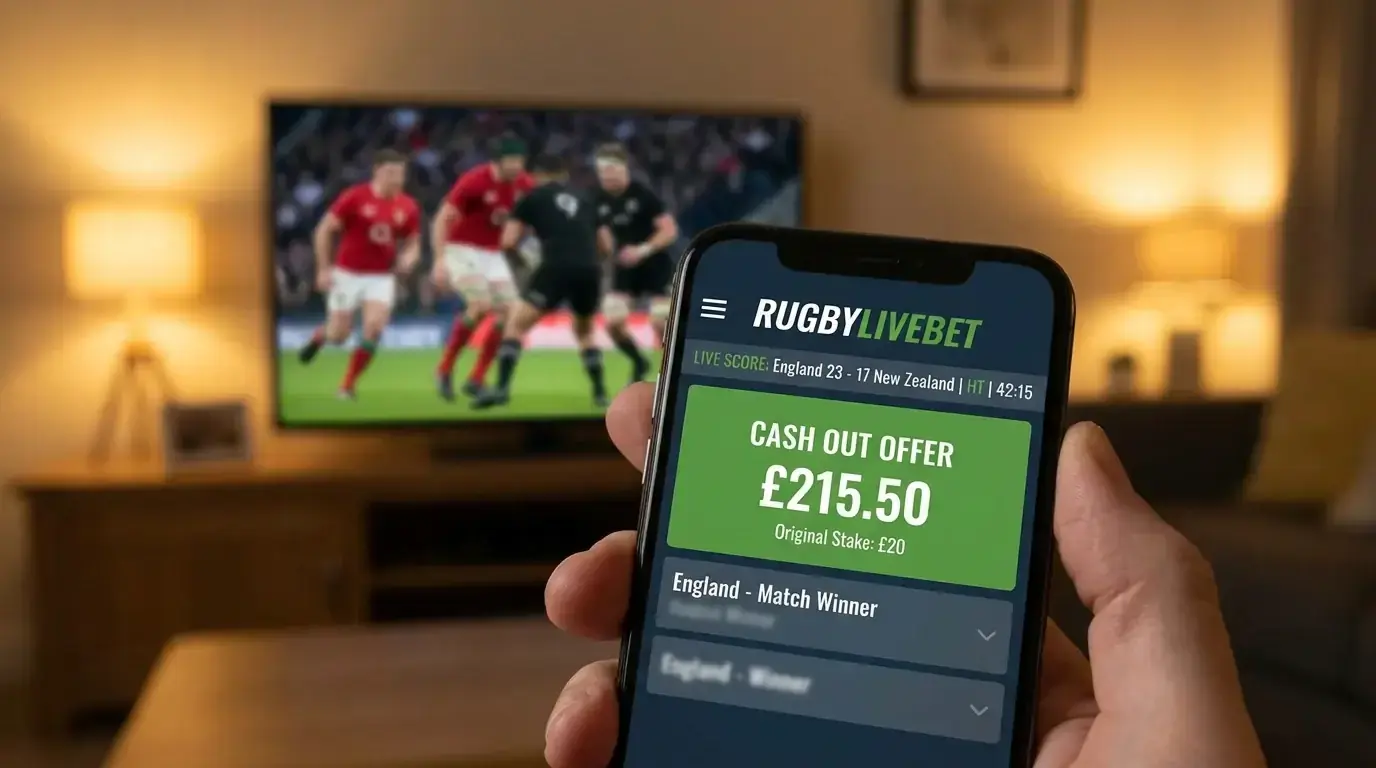
The discipline that matters is deciding, before you bet, roughly when you’d consider cashing out and why, rather than improvising it in the heat of a live match when the price is jumping and your judgement is compromised by the very momentum you’re trying to assess. A plan made calmly beats a decision made in panic, every time. Cash out exploited well is a quiet risk-management tool. Cash out used badly is a fast way to convert the bookmaker’s margin into a habit.
Watching the Rugby While You Bet
You cannot bet live rugby well without watching it live, and the gap between watching and reacting to a scoreboard is the difference between informed in-play betting and blind guessing. The live market prices the situation, and you can only judge whether the price is wrong if you can see the situation, the territory, the momentum, the body language, the things a scoreline never tells you.
Many UKGC-licensed operators offer live streaming of rugby matches directly within their platforms, letting you watch and bet in the same place, and the integration is genuinely useful because it removes the lag between seeing an event and being able to act on it. When the stream, the odds, and the bet slip sit on one screen, your reaction time tightens and your read on the match feeds straight into your betting. The streams aren’t universal, coverage varies by competition and by operator, and the bigger the match the more likely it’s available, but where they exist they transform in-play from guesswork into something closer to skilled observation.
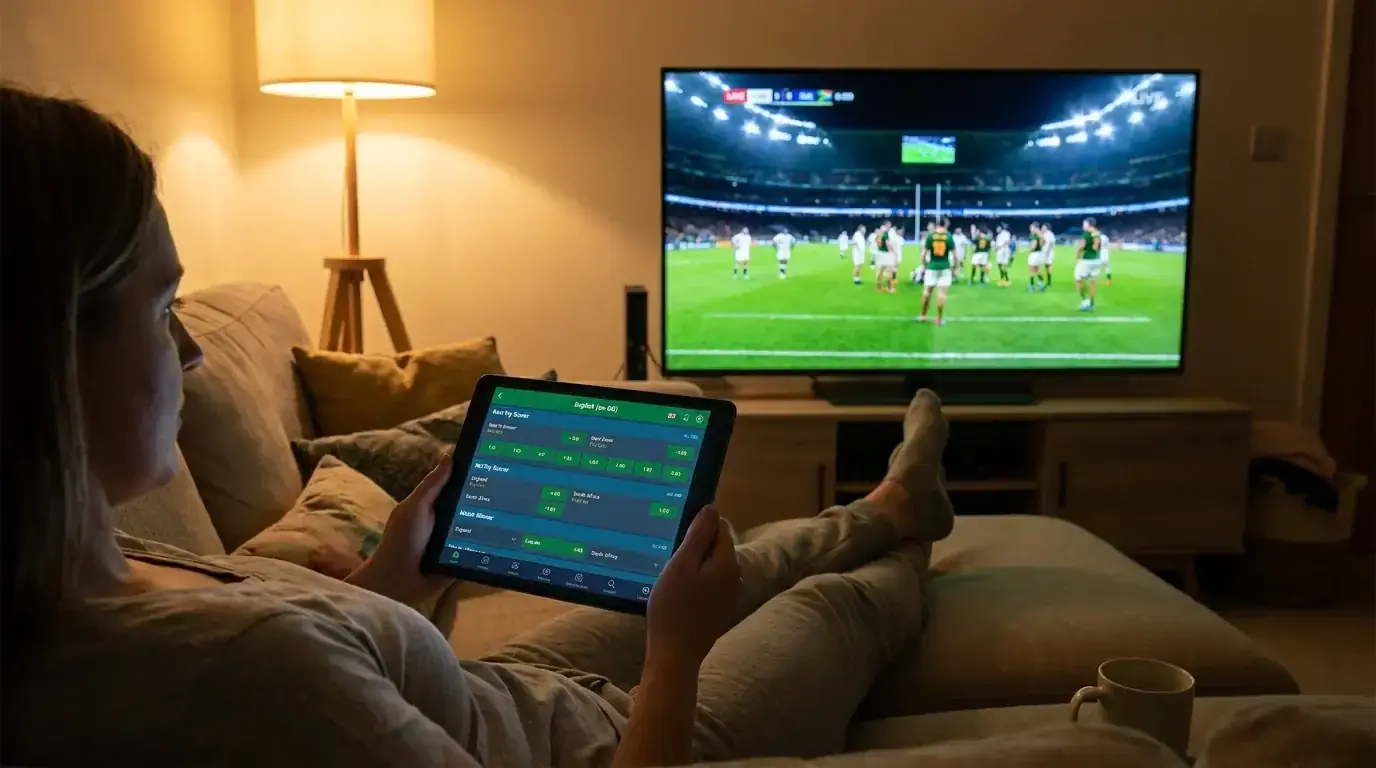
There’s a hard practical wrinkle, though, and it bites in-play punters constantly: latency. Any stream, and especially a free in-platform one, runs several seconds behind the live event, sometimes more. The bookmaker’s odds, by contrast, update from a faster data feed, often the same near-instant feed the traders use. This means the price can move before you see the event that caused it on your screen. You watch a side break clear, reach to back them, and the price has already shortened because the market knew before your stream showed you. Betting against a delayed picture is betting blind in a way that’s easy to miss until it’s cost you.
The mechanical speed of the betting itself cuts the other way and helps you. Mobile apps let you place a bet in under ten seconds, using saved stakes, biometric confirmation, and one-tap interfaces, so once you’ve decided, execution is near-instant. That speed is a genuine asset in a market that moves fast, but it’s also a hazard, because the same frictionless interface that lets you act on a considered read also lets you act on a thoughtless impulse just as quickly. Speed serves the disciplined punter and ruins the reactive one.
My rule is simple: don’t bet live on a match you can’t watch, and account for stream delay when you do. If the only picture available lags the market, treat the live odds with suspicion, because by the time the event reaches your eyes the price has already adjusted, and the value you think you’re seeing has usually gone. Watch properly or don’t bet live at all. The market is too fast and too well-informed to beat from a delayed scoreboard and a hunch.
What the In-Play Numbers Reveal
Step back from any single match and the data tells a clear story about where betting has gone and what that means for you. In-play isn’t a niche feature any more, it’s the centre of gravity, and understanding the scale of it explains both the opportunity and the risk in stark terms.
Live and in-play betting accounted for 62.35% of the sports betting market in 2025, and on some platforms in-play now makes up more than half of all turnover. That’s a structural transformation, not a passing trend. The industry has reorganised itself around the live market, pouring development into faster feeds, richer market menus, and the seamless watch-and-bet experience, because that’s where the money flows. For you as a punter, it means the live market is deep, liquid, and sophisticated, which cuts both ways: the prices are sharp and well-formed on big matches, but the bookmaker’s modelling is sharp too, so soft prices are rarer and harder-won than the abundance of markets suggests.
The participation data is more reassuring about the human scale of it. Among UK online gamblers, 21% had placed an in-play bet in the previous four weeks, and the average online gambler holds three operator accounts. Those numbers tell you in-play is mainstream but not universal, a substantial minority engage with it regularly, and that the multi-account habit, which lets punters take the best live price across books, is widespread. The implication for your own betting is that line shopping applies live too: the same in-play selection is priced differently across operators, and the punter checking two or three screens can take the sharpest number even in a fast market.
What the numbers don’t show, and what matters most, is the behavioural pattern underneath them. The live market’s dominance is built partly on engagement, the format is more compelling, more continuous, more immersive than pre-match, and that engagement is precisely what makes it risky for the undisciplined. The same features that make in-play the industry’s growth engine, speed, immediacy, constant fresh markets, are the features that invite over-betting. The data on market share is, read one way, data on how effectively the live format captures and holds the bettor’s attention.
The honest reading of the in-play numbers is that the format rewards exactly two things: skill and restraint. The skill to read a live match better than the price, and the restraint to bet only when you’ve genuinely got an edge rather than every time a market refreshes. The 62% market share isn’t evidence that in-play is the smart way to bet. It’s evidence that in-play is the engaging way to bet, and the gap between engaging and profitable is where the discipline in the next section earns its keep.
Keeping Discipline When the Match Is Live
The hardest part of in-play betting isn’t reading the odds. It’s not betting. The market refreshes every few seconds, every market offers a fresh temptation, and the whole environment is engineered to keep you wagering. Holding your discipline against that current is the single most important skill a live punter can develop, and it’s the one that separates the people who profit from the people who fund the profits.
Set your limits before the match, not during it. Decide how much of your bankroll the entire match is allowed to cost you, decide your unit stake, and decide roughly how many live bets you’ll consider, then hold those lines no matter what unfolds. The discipline that protects you is the same fixed-fraction approach that protects pre-match bettors, staking a small, consistent slice of your bankroll per bet, but it’s harder to honour live because the speed and emotion are working against you. Problem gambling in Britain affects around 0.5% of the population, and the behaviours that lead there, chasing, escalating, betting on impulse, are all amplified by exactly the live environment that makes in-play so engaging.
Chasing is the cardinal sin and the live market is purpose-built to invite it. You lose a next-try bet, another market opens within seconds, and the urge to win it straight back is immediate and intense. Resist it without exception. A loss is not a debt to be recovered on the next play; it’s a closed bet, and the next market should be assessed on its own merits or, far more often, ignored entirely. The punter who treats every refreshed market as a chance to get even is the punter the live format profits from most reliably.
Watch for the emotional tells in yourself. Betting bigger because you’re winning and feel invincible. Betting bigger because you’re losing and feel desperate. Betting more often as the match builds to a climax and the adrenaline rises. All three are signals to stop, not to continue, and the disciplined live punter learns to read their own state as carefully as they read the match. If you notice you’re betting on feeling rather than judgement, close the app. The match will end whether you bet on it or not.
The deposit limits and time-out tools every UKGC-licensed operator must provide are worth using actively, not as a last resort but as a routine guard rail. Set a deposit limit that caps your live betting before you start, and treat a session time-out as a normal pause rather than an admission of trouble. The whole point of in-play discipline is to bring the calm of pre-match decision-making into the heat of the live market, and the tools exist precisely to help you do that. Used well, in-play rewards the punter who can watch a match closely, spot the moment the price lags the situation, act once, and then sit on their hands until the next genuine edge appears, which is far rarer than the refreshing markets would have you believe.
