


The biggest welcome offer I ever signed up for turned out to be the worst value of the lot, because the headline number was wrapped in wagering requirements so steep that extracting any real money from it was nearly impossible. That experience taught me the rule I now apply to every sign-up offer: the size of the bonus tells you almost nothing, and the terms tell you everything. Welcome bonuses and free bets are how bookmakers compete for new rugby punters, and reading the small print before you are seduced by the big number is the difference between a genuine boost and a frustrating mirage.
These offers come in several shapes, matched deposits, free bets, bonus funds, each with its own conditions governing how you qualify, how you must use the bonus, and whether you can ever turn it into withdrawable cash. They are legitimate promotions from licensed operators, but they are designed to encourage betting, not to give money away, so understanding their mechanics is essential. This is how to read a rugby welcome offer for what it is really worth rather than what its headline claims.
The shapes a welcome offer takes
Welcome offers are not all the same, and the structure of an offer matters as much as its size, because different types deliver value in very different ways. Knowing the common shapes lets you compare offers on substance rather than headline.

The most common types fall into a few categories. A matched-deposit bonus gives you bonus funds equal to some proportion of your first deposit, so depositing a set amount might be matched with the same in bonus money, subject to conditions on how that bonus can be used and withdrawn. A free-bet offer gives you one or more bets to place at the operator’s risk, typically after you place a qualifying bet of your own, with the winnings, but usually not the stake, returned to you if the free bet lands. Some offers combine elements, or take the form of a “bet and get,” where placing a qualifying bet unlocks free bets regardless of whether the qualifying bet wins. Each structure delivers its value differently, and a large matched deposit with harsh conditions can be worth less than a modest free bet with clean terms.
The key insight is that the headline figure is the marketing, not the value. A bonus advertised as a large sum is only worth what you can realistically extract from it after meeting the conditions, and those conditions vary enormously between superficially similar offers. Every UK-licensed operator is bound by the Gambling Commission’s framework, which includes requirements around how promotions are presented and how their terms are disclosed, so the full conditions are always available to read, but they are rarely as prominent as the headline. The first discipline of evaluating any welcome offer is to ignore the big number until you have found and understood the terms that govern it, because the structure and conditions, not the advertised amount, determine what the offer is actually worth to you.
Reading the terms that govern the offer
The terms and conditions are where a welcome offer’s true value lives or dies, and the wagering requirement is the single most important term to understand. It is the condition that most often turns a generous-looking bonus into something far harder to benefit from than it appears.

A wagering requirement, sometimes called a playthrough or rollover, specifies how many times you must stake the bonus, or the bonus and deposit, before you can withdraw any winnings derived from it. A bonus with a wagering requirement of, say, several times its value means you must place bets totalling many multiples of the bonus before the resulting funds become withdrawable cash, and the higher that multiple, the harder the bonus is to convert into real money. A modest bonus with a low wagering requirement can be worth far more than a large one with a steep requirement, because the steep requirement may force so much betting, with the bookmaker’s margin applied each time, that little or nothing survives to withdraw. This is precisely why the headline figure misleads: two offers of the same size can have wildly different real values depending on their wagering terms.
Beyond the wagering requirement, several other terms shape an offer’s value and must be read. There is usually a minimum qualifying deposit and a minimum odds requirement on qualifying and bonus bets, which prevents you from meeting the wagering requirement by betting on near-certainties at tiny prices. There are time limits within which the bonus must be used or the wagering completed, after which it expires. There may be restrictions on which markets or bet types count towards the wagering requirement, and limits on the maximum you can win or withdraw from the bonus. Every UK-licensed operator must make these terms available, so the information is there to be read; the discipline is actually reading it before opting in. I treat the wagering requirement, minimum odds, time limit and market restrictions as the four terms that determine an offer’s worth, and I evaluate every welcome bonus against them rather than against its headline.
How free bets actually work
Free bets are the most common form of welcome value and the most widely misunderstood, because the way they pay out differs in a crucial respect from a normal bet. Grasping that difference is essential to valuing a free-bet offer correctly.
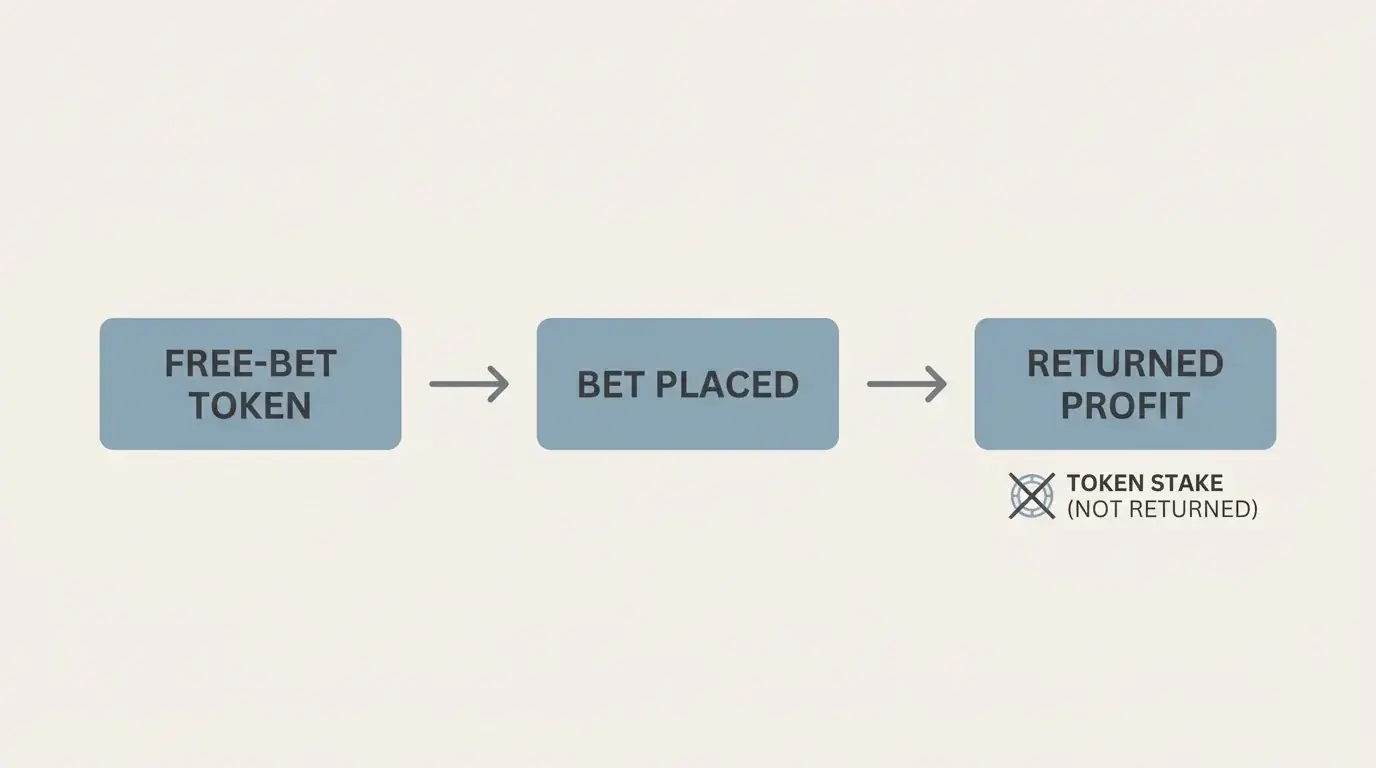
The defining feature of a standard free bet is that the stake is not returned with your winnings. When you place a normal cash bet and it wins, you receive your winnings plus your original stake back; when you place a free bet and it wins, you typically receive only the winnings, with the free-bet stake retained by the operator. So a free bet placed at evens that wins returns the winnings equal to the stake, not double the stake as a cash bet would, which means a free bet is worth meaningfully less than its face value, commonly around seventy to eighty per cent of an equivalent cash stake depending on the odds. This is the single most important thing to understand about free bets: a free bet is not the same as free cash, because the stake stays with the bookmaker.

The odds at which you use a free bet therefore affect its value in a way that runs counter to intuition for cash betting. Because only the winnings are returned, using a free bet on a longer-priced selection extracts more potential value from it than using it on a short-priced favourite, since the winnings on a longer price are a larger multiple of the stake. This does not mean recklessly betting free bets on outsiders, which lose more often, but it does mean a free bet’s value is best realised at meaningful odds rather than on near-certainties. I treat free bets as worth somewhat less than their headline value, use them at sensible odds to extract reasonable winnings, and never make the beginner’s error of assuming a free bet is equivalent to the same amount of cash. Understanding the stake-not-returned mechanic is what lets you value a free-bet offer for what it genuinely delivers.
Working out whether an offer is worth taking
With the structures, terms and mechanics understood, the final step is putting them together to judge whether a given welcome offer is actually worth claiming, because some are genuinely good value and others are not worth the effort. A clear-eyed evaluation protects you from chasing offers that cost more than they give.

The evaluation comes down to weighing the realistic extractable value against the betting the offer requires you to do. An offer with a reasonable bonus, a low wagering requirement, fair minimum odds and a sensible time limit can be genuinely worth claiming, delivering real value for betting you might broadly have done anyway. An offer with a large headline bonus but a steep wagering requirement, restrictive minimum odds and a tight time limit may require so much betting, at the bookmaker’s margin, that the expected value is poor or even negative once you account for the likelihood of the wagering grinding the funds away. The discipline is to judge the offer on its realistic net value, not its advertised size. It also matters that the average British online player holds around three accounts and over half are registered with more than one operator, which means new punters can and do compare welcome offers across operators, so there is every reason to choose the offer with the best genuine terms rather than the biggest headline.
The most important principle, though, is that a welcome offer should never drive you to bet beyond what you would otherwise do or deposit more than you intended. The offers are designed to encourage betting, and the trap is letting the lure of a bonus pull you into larger deposits, riskier bets or more betting than you are comfortable with simply to satisfy a wagering requirement. I evaluate welcome offers as a minor, occasional bonus on betting I was going to do regardless, claim only those whose terms genuinely stack up, and never let an offer dictate my staking or my deposits. A good welcome offer is a small edge worth taking on your own terms; a bad one, or a good one chased recklessly, is a way for the bonus to cost you more than it is worth. Read the terms first, evaluate honestly, and let the offer serve your betting rather than the other way round. For confirming that the operator behind any welcome offer is properly regulated before you deposit, my guide to verifying a UKGC-licensed rugby betting site covers the essential safety check.
