

The first rugby bet I ever placed took me eleven minutes to confirm, and most of that was me hovering over the stake box wondering whether I’d done something wrong. I hadn’t. Placing a wager on the oval ball is mechanically simple once you’ve done it once, but nobody walks you through the actual sequence of taps and clicks. Around 10% of the UK population now bets on sport online, and a fair chunk of them stumbled through that first slip exactly the way I did.
This guide is about the doing, not the deciding. I’m not going to compare operators or rank bet types here, because those are separate jobs covered elsewhere. What I want to hand you is the muscle memory: how to pick a licensed site, open an account, fund it, find a rugby market, build a slip, set a sensible stake, and press the button with confidence. Everything from the moment you decide to bet to the moment your selection is locked in.
I’ve been analysing rugby markets for six years, and the questions I get from newcomers almost never concern strategy. They concern the plumbing. Where do I click? Is this the right screen? Why is the price different now? Those are the gaps this article fills, in the order you’ll actually hit them. By the end you’ll have placed a bet start to finish, understood why each step exists, and sidestepped the mistakes that catch nearly everyone out on their first weekend.
Choosing a Licensed Site Before You Spend a Penny
A mate of mine once signed up to a slick-looking sportsbook he’d found through a forum, deposited forty quid, and spent three weeks trying to get it back when the site went dark. The site wasn’t licensed in Britain. That single detail is the difference between a regulated environment with real recourse and a void where your money simply evaporates, and it’s the very first thing you check before anything else.
Every operator serving UK residents must hold a licence from the UK Gambling Commission, the regulator created under the Gambling Act 2005. A UKGC licence isn’t a rubber stamp. It obliges the operator to ring-fence your funds, hand you protective tools like deposit limits and self-exclusion, and submit to oversight you’ll never see but will quietly benefit from. The talkingrugbyunion editorial team put it neatly when summarising the regulator’s own line, noting that major sporting events keep playing an important role in betting engagement within regulated markets. The word that matters there is regulated.
Checking the licence takes thirty seconds. Scroll to the footer of any operator’s homepage and you’ll find a licence number and a statement that the company is licensed and regulated by the UK Gambling Commission. You can take that number to the Commission’s public register and confirm it matches. If a site won’t show you a number, or the number doesn’t check out, you close the tab. There is no second consideration, no “but the welcome offer looks great”. An unlicensed bonus is bait on a hook.

Beyond the licence, a few practical filters help you narrow the field. Look for genuine rugby depth rather than football with a rugby afterthought tacked on. The better books carry both codes, union and league, across the tournaments a British punter actually follows: the Six Nations, the Gallagher Premiership, the United Rugby Championship, and Super League. Check that they price more than the bare match result, because a site offering only “who wins” will frustrate you within a fortnight.
One habit worth forming early, and one most experienced punters share, is holding accounts at more than one operator. UK online gamblers carry three operator accounts on average, and 56% are registered with more than one. That isn’t greed or disorganisation. Prices for the same rugby match differ between books, sometimes meaningfully, and having two or three accounts lets you take the best available number rather than the first one you see. You don’t need three on day one. You need one good, verified, licensed account, and the awareness that adding a second later is normal practice, not a sign you’ve lost the run of yourself.
Opening an Account and Funding It
Registration is the part newcomers dread and the part that turns out to be the most boring. You’ll fill in a form, prove you are who you say you are, and move money in. That’s it. The dread comes from the identity checks, so let me demystify those, because they trip people up purely through surprise.
When you register, the operator asks for your name, date of birth, address, and email. It then runs a verification check, often called Know Your Customer, to confirm you’re a real adult resident in the UK. Sometimes this clears instantly in the background. Sometimes the site asks you to upload a photo of your passport or driving licence and a recent utility bill or bank statement. This isn’t the operator being nosy. It’s a legal requirement, and doing it at sign-up rather than at withdrawal saves you a headache later, because an unverified account can take deposits but will freeze when you try to take winnings out.

Do the verification properly and immediately. Upload clear photos, make sure the address matches your registration, and wait for confirmation before you go further. I’ve watched too many first-timers win a tidy sum on a Saturday and then spend Sunday raging at a “pending verification” message they could have cleared days earlier.
Funding the account comes next. UK operators accept debit cards, bank transfers, and e-wallets such as PayPal. Credit cards have been banned for gambling in Britain since 2020, so don’t go looking for that option. Pick a method, enter the amount, and the balance appears in your account, usually within seconds for cards and e-wallets. A note worth internalising: deposit only what you’ve already decided you can afford to lose, and consider setting a deposit limit during sign-up. Most sites offer this as a toggle, and it caps how much you can pay in over a day, week, or month. Setting it early, when you’re calm and clear-headed, is far easier than wrestling with the decision mid-session.
Where you do all this matters more than you’d think. The overwhelming majority of online gambling in Britain happens at home, and among 18 to 24 year olds, 76% of those who gamble online do it from a smartphone. If you’re betting from your phone on the sofa, you’re in the statistical mainstream. The mechanics are identical to desktop, just compressed onto a smaller screen, and most operators run a dedicated app that’s a touch slicker than the mobile website. Either works for placing your first bet.
Finding the Rugby Markets
Here’s where new punters get genuinely lost, and it’s not their fault. Sportsbook navigation is built for people who already know where everything lives. The homepage shows you football, horse racing, and whatever’s trending, and rugby can feel buried. It isn’t. You just need the route.
On nearly every UK site, there’s an A to Z sports list or a sports menu, usually down the left on desktop or behind a menu icon on mobile. Rugby appears under two headings you must not confuse: rugby union and rugby league. These are different sports with different rules, different scoring, and entirely separate fixtures. Tap into the one you want and you’ll see a list of competitions. For union, that’s your Six Nations, Premiership, URC, Top 14, and international tests. For league, it’s Super League and the Challenge Cup. Pick a competition and you reach the fixtures, the actual matches with dates, kick-off times, and a headline price.
Tap a single fixture and the market screen opens. This is the heart of it. The match result sits at the top, often labelled as the win-draw-win or simply the three-way market. Below that you’ll find the handicap, where one team is given a points head start or deficit to even up the contest. Then total points, an over or under line on the combined score. Then a sprawl of other markets: first try scorer, anytime try scorer, half-time leader, winning margin, and on the bigger games a hundred and fifty markets or more on a single match.
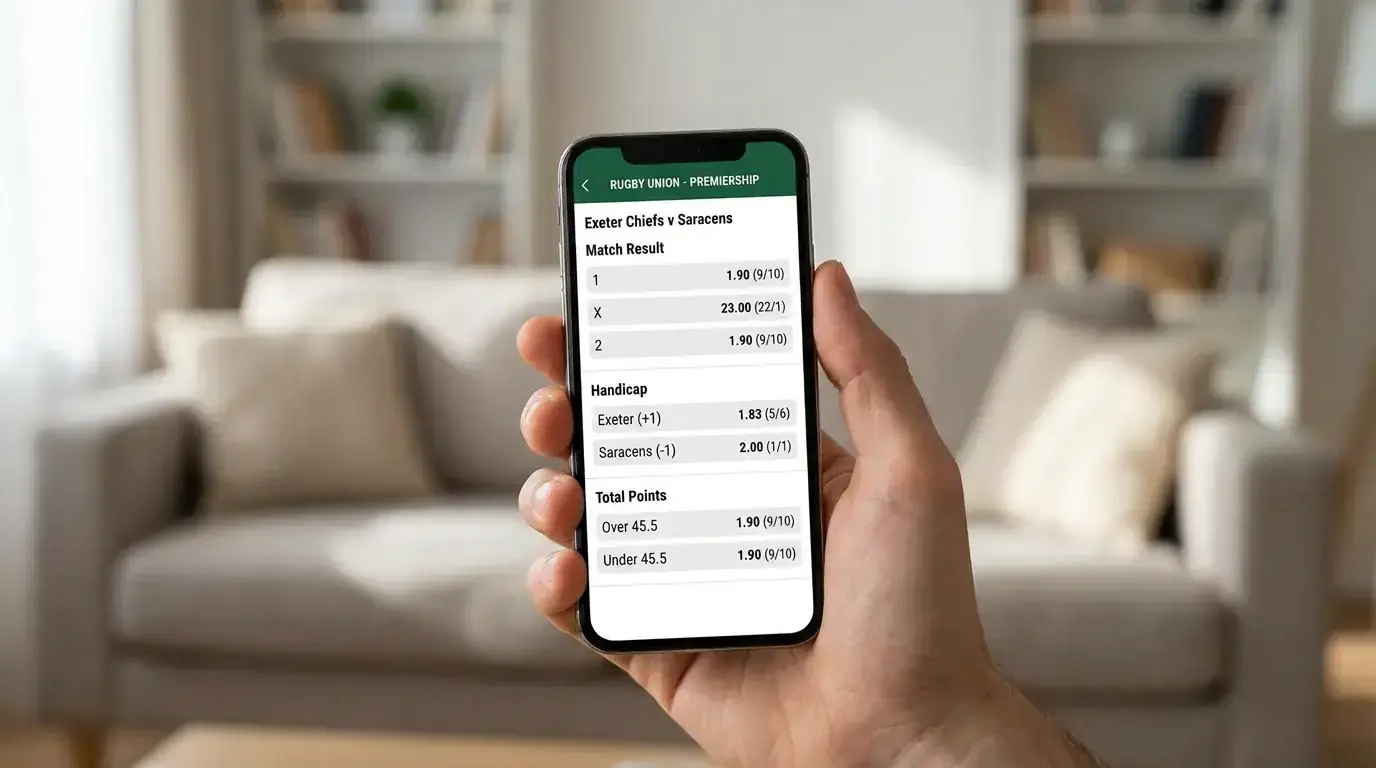
Don’t be intimidated by the volume. For your first bet, you want one of the top three: match result, handicap, or total points. Around 60% of all rugby bets land on match outcome and margin markets combined, so by sticking to those you’re doing exactly what the bulk of experienced punters do. The exotic markets are fun and have their place, but they’re not where you learn the ropes.
One thing that confuses beginners constantly: the price you see in the fixture list might differ slightly from the price on the market screen, and prices shift as money comes in and team news breaks. That’s normal. The number isn’t broken. Rugby odds move because the book is constantly rebalancing its position, and what you ultimately get is the price showing when you confirm, not the one that first caught your eye. Learning to read those numbers properly is its own skill, and I’ve written a full breakdown of how fractional and decimal odds actually work if you want to go deeper before you stake.
Building the Bet Slip
The bet slip is the trolley of online betting. You tap a selection, it drops into the slip, and nothing leaves your account until you check out. I labour this point because the single most common first-timer worry I hear is “did I just bet by accident?” You didn’t. Tapping a price adds a selection. It does not place a bet. The bet happens only when you enter a stake and hit the confirm button on the slip itself.
When you tap a rugby price, the slip slides into view, usually on the right on desktop or as a pop-up tab on mobile showing how many selections it holds. With one selection, you’re building a single bet, the simplest and the one I’d insist any beginner starts with. The slip displays your selection, the current odds, a box for your stake, and a calculated potential return that updates live as you type.
If you add a second selection from a different match, the slip gives you options. You can place them as two separate singles, each standing on its own, or combine them into an accumulator, an “acca”, where both must win for the bet to pay but the combined odds multiply into something far larger. Accas are seductive and they are where beginners haemorrhage money, because the maths that makes the potential return glitter is the same maths that makes winning vanishingly unlikely. Add a third leg, a fourth, and you’re buying a lottery ticket with extra steps. Start with singles. Earn the right to get fancy.

The slip also shows the stake and the return clearly separated. The stake is what you risk. The return, on a winning bet, is your stake back plus your profit. So a £10 single at 2.00 returns £20: your tenner back and a tenner of winnings. Get comfortable reading those two numbers, because misreading them, thinking the return is pure profit on top of your stake, is a classic early stumble that warps how people judge value.
Before you confirm, the slip is fully editable. Remove a selection, change the stake, switch a single to part of an acca. Nothing is committed. Take a breath here. The slip is the last calm moment before the bet is live, and it’s the right place to ask yourself whether the stake is one you genuinely chose or one the round number simply suggested.
Staking Sensibly and Protecting Your Bankroll
I’ll tell you the truest thing in this entire guide: the size of your stake matters more than the cleverness of your pick. You can be right more often than the bookmaker and still go broke by staking erratically. This is the part nobody finds glamorous and everybody who lasts takes seriously.
Your bankroll is the total pot you’ve set aside for betting, money you’ve already decided you can afford to lose without it touching your rent, your bills, or your peace of mind. The discipline is treating that pot as finite and staking a small, consistent fraction of it per bet rather than chasing a feeling. A common, sane approach is one to two per cent of your bankroll on a single bet. With a £200 bankroll, that’s two to four pounds a wager. It sounds modest. It is meant to. The point is to survive the inevitable losing runs long enough for your judgement to show.

The reason this matters runs deeper than arithmetic. Problem gambling in Britain affects around 0.5% of the population, and while that figure is mercifully small, the behaviours that lead there almost always start with staking that scales to emotion rather than to plan. Chasing losses, doubling up to “get it back”, betting bigger when you’re winning because you feel invincible. A fixed-fraction staking rule is a seatbelt. You won’t notice it most of the time, and you’ll be very glad of it on the day it matters.
Set a deposit limit if you haven’t already, and treat it as a wall, not a suggestion. Decide your unit stake before you open the fixture list, not after a price tempts you. And keep the maths honest: a bet that could return £80 from a £4 stake is exciting, but if it comes off once in thirty attempts, it’s a worse use of your bankroll than a dull-looking single you’ll win two times in three. Glamour and value rarely sit in the same market.
One last habit. Write down what you stake and what happens. A simple note on your phone is enough. Punters who track their betting see it clearly for what it is, while those who don’t remember the wins and forget the losses, which is how a losing month feels like a winning one until the statement arrives.
Placing Your First Bet, Tap by Tap
Let me walk you through a complete, real-feeling sequence so the whole thing clicks into place. We’ll use a fictional but realistic example: a Six Nations Saturday, you’ve an account with a verified balance, and you fancy a single on the home side. Britain sees around 290 million online bets placed on real events every month, and yours is about to join them. Here’s exactly how.
You open the app and tap into rugby union. You select the Six Nations, then the fixture, let’s say a home favourite against a mid-table visitor. The match result market sits at the top. The home side is priced at 1.50, the draw at 26.00, the away side at 2.75. You decide the home win at 1.50 is too short for your taste, so you scroll to the handicap, where the home team is offered at minus 9.5 points, meaning they must win by ten or more for the bet to land. That handicap is priced at, say, 1.90.
You tap 1.90. The selection drops into your bet slip. You open the slip, and there it is: home team minus 9.5, odds 1.90, an empty stake box. You’ve set your unit at £4, so you type 4 into the box. The slip instantly shows a potential return of £7.60: your £4 back plus £3.60 profit. You read it twice, because reading the slip carefully is a habit worth building from bet one.
You check the details. Right match, right market, right stake. Everything as intended. You press the confirm button. The slip processes for a second, then shows a confirmation: bet placed, with a receipt or bet ID. That ID is your proof the wager exists, and it’ll appear in your account’s open bets or bet history section. You can watch it there as the match unfolds.

That’s the entire act. No ceremony, no hidden step. The home side wins by fourteen, your handicap lands, and £7.60 settles into your balance shortly after the final whistle. Or they win by seven, the handicap misses, and your £4 is gone, which is exactly the amount you decided in advance you could lose. Either way, you’ve done it properly: licensed site, verified account, sensible stake, a market you understood, and a slip you read before confirming. The next bet will take you ninety seconds, not eleven minutes.
The Mistakes That Catch Nearly Everyone
I keep an informal mental list of the errors I see beginners make, and the striking thing is how predictable they are. Almost nobody invents a new way to lose money. They make the same handful of mistakes everyone makes, and knowing them in advance is the cheapest education available.
The first is betting without verifying the account, then discovering at withdrawal that the winnings are frozen until identity checks clear. Do the KYC at sign-up. The second is the accumulator trap: a four or five-leg acca that turns a sensible stake into a near-certain loss dressed up as a dream. The combined odds look thrilling precisely because every additional leg slashes the probability of the whole thing landing. Singles first, always.
The third is chasing. You lose a bet, so you place a bigger one to recover, lose that, go bigger again. This is the single most destructive pattern in betting and it has nothing to do with rugby and everything to do with emotion overriding the staking plan you set when you were calm. The fixed-fraction stake exists to stop exactly this, but only if you honour it under pressure.
The fourth is misreading the slip, confusing potential return with profit, and so misjudging whether a price is generous or mean. The fifth is taking the first price you see when a second account would have offered better, a small leak that compounds over a season. And the sixth, quietly the most important, is betting money that was never truly disposable, money earmarked for something real. If a bet’s outcome would change how you sleep, the stake was wrong before the match kicked off.
None of these are sophisticated. That’s the point. The skill in betting isn’t avoiding clever traps, it’s refusing to fall for obvious ones when excitement makes them feel reasonable. Get the mechanics right, stake within a plan, read every slip before you confirm, and you’ll already be betting more sensibly than most of the people who’ve been doing it for years.
